
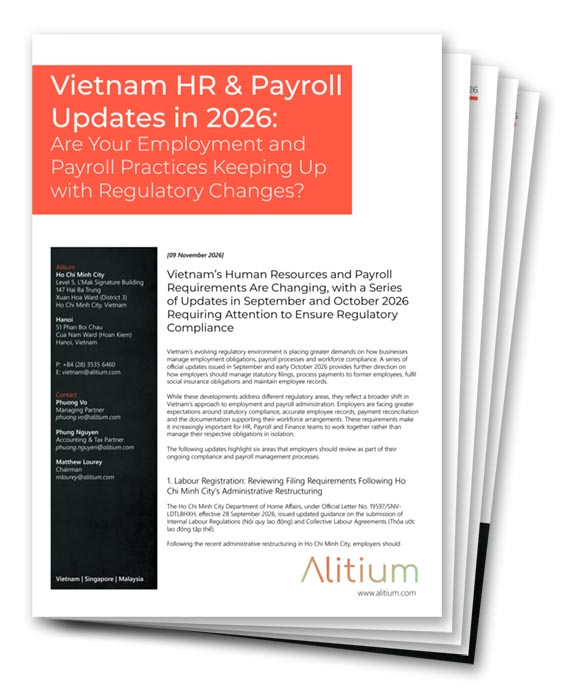
Vietnam’s Human Resources and Payroll Requirements Are Changing, with a Series of Updates in September and October 2026 Requiring Attention to Ensure Regulatory Compliance
Vietnam’s evolving regulatory environment is placing greater demands on how businesses manage employment obligations, payroll processes and workforce compliance. A series of official updates issued in September and early October 2026 provides further direction on how employers should manage statutory filings, process payments to former employees, fulfil social insurance obligations and maintain employee records.
While these developments address different regulatory areas, they reflect a broader shift in Vietnam’s approach to employment and payroll administration. Employers are facing greater expectations around statutory compliance, accurate employee records, payment reconciliation and the documentation supporting their workforce arrangements. These requirements make it increasingly important for HR, Payroll and Finance teams to work together rather than manage their respective obligations in isolation.
The following updates highlight six areas that employers should review as part of their ongoing compliance and payroll management processes.
1. Labour Registration: Reviewing Filing Requirements Following Ho Chi Minh City’s Administrative Restructuring
The Ho Chi Minh City Department of Home Affairs, under Official Letter No. 19597/SNV-LDTLBHXH, effective 28 September 2026, issued updated guidance on the submission of Internal Labour Regulations (Nội quy lao động) and Collective Labour Agreements (Thỏa ước lao động tập thể).
Following the recent administrative restructuring in Ho Chi Minh City, employers should review the competent receiving authorities and applicable submission arrangements to ensure that statutory filings are directed to the correct office.
This is particularly relevant to enterprises employing 10 or more employees, which are generally required to register their Internal Labour Regulations with the competent labour authority.
Businesses should consider:
- reviewing the current authority responsible for receiving labour-related submissions;
- updating internal filing instructions and responsible personnel;
- checking whether existing submission procedures remain appropriate under the revised administrative structure; and
- ensuring that upcoming registrations and amendments are supported by the required documentation.
Employers with multiple business locations should pay particular attention to their filing arrangements to avoid unnecessary administrative delays or submissions to the wrong authority.
2. PIT Withholding on Payments Made After Employment Termination
Payments made after an employee’s departure can create additional PIT withholding obligations, particularly where final payroll items are processed separately from the employee’s regular monthly salary.
Under Official Letter No. 13510/TTPHCM-QLDN3 dated 21 September 2026, the Ho Chi Minh City Tax Department clarified the PIT withholding treatment applicable to salary and wage payments made after an employment contract has ended.
Where taxable salary or wage income of VND 5 million or more is paid on each occasion after termination, the employer is required to withhold PIT at 10% under the applicable rules.
Similar guidance has also been issued by tax authorities in Dong Nai, Ninh Binh, Can Tho and other localities, indicating the importance of applying the relevant withholding rules when settling post-termination employee entitlements.
In practice, this may affect outstanding salaries, bonuses, unused annual leave payments, salary adjustments and other employment-related payments processed after the termination date.
Employers should ensure that:
- Each payment is properly classified according to its nature and applicable PIT treatment.
- The relevant withholding obligation is assessed before processing the payment.
- Payment dates, withholding amounts and supporting payroll records are accurately documented.
- HR and Finance teams coordinate to ensure that final settlement procedures are consistently applied.
A well-defined employee offboarding process should account for tax obligations arising not only at the termination date but also from subsequent payments. This helps minimise withholding errors and potential tax adjustments during future reviews.
3. Social Insurance: Strengthening Compliance Controls and Managing Enforcement Risks
Decree No. 283/2026/NĐ-CP, effective 10 September 2026, introduced an updated administrative penalty framework for violations in labour, Social Insurance (SI), Unemployment Insurance (UI) and Vietnamese employees working overseas under contracts.
Following the Decree’s implementation, Vietnam Social Security issued Official Letter No. 3688/BHXH-KT dated 18 September 2026, providing guidance on consistent implementation.
These developments reinforce the importance of maintaining accurate employee participation records and fulfilling statutory contribution obligations. Employers should pay particular attention to:
- Contribution obligations: ensuring eligible employees are registered and contributions are paid fully and within the prescribed deadlines.
- Employee participation data: maintaining accurate information on employee details, salary levels and participation periods.
- Supporting documentation: ensuring employment contracts, payroll records, insurance declarations and supporting documents are consistent.
Social Insurance compliance should not be viewed solely as a payment obligation. Discrepancies between employment documentation, payroll calculations and insurance declarations may create compliance exposure even where contributions have generally been made.
Businesses should consider a targeted review of outstanding contribution balances, employee participation records and supporting documentation to identify potential gaps before they develop into more significant issues.
4. Social Insurance Payments and Electronic Reconciliation: Getting the Payment Details Right
Vietnam Social Security, under Official Letter No. 3779/BHXH-TCKT dated 24 September 2026, announced the nationwide electronic exchange of payment data with the State Treasury from 1 October 2026, supporting the automated recognition and reconciliation of Social Insurance, Health Insurance (HI) and Unemployment Insurance contributions.
Under the new arrangement, the prescribed payment reference and information structure are important for ensuring that contributions are correctly identified and recorded against the relevant employer account.
Incorrect or incomplete payment information may prevent automated recognition, resulting in additional reconciliation work or delays in confirming contribution records.
For employers, this change has direct implications for the coordination between Payroll and Finance teams. Even where the contribution amount is correct and the transfer has been completed, errors in payment references may still create administrative difficulties.
Businesses should therefore:
- review existing Social Insurance payment templates and banking instructions;
- ensure the prescribed payment reference format is consistently applied;
- update internal payment procedures where necessary; and
- coordinate between Payroll and Finance to verify payment details before submission.
This is particularly relevant for businesses processing contributions across multiple employee groups or employing entities.
5. Electronic Social Insurance Books and Updated Administrative Procedures: Employee Data Readiness
Vietnam’s transition towards digital Social Insurance administration places greater emphasis on the accuracy and consistency of employee information.
Two developments issued in late September and early October 2026 are particularly relevant.
First, under Notice No. 8362/TB-BHXH dated 5 October 2026, Ho Chi Minh City Social Security provided further guidance on implementing electronic Social Insurance books alongside digital identification and Social Insurance platforms. Employees are encouraged or required, as applicable, to update their personal information, including registered email addresses and relevant digital identification details.
Second, the Ministry of Finance issued Decision No. 2695/QĐ-BTC dated 29 September 2026, revising four groups of administrative procedures relating to Social Insurance and Health Insurance:
- Compulsory Social Insurance, Health Insurance, Unemployment Insurance and occupational accident and disease insurance, covering registration, adjustments, Social Insurance book management and Health Insurance card issuance.
- Voluntary Social Insurance participation.
- Health Insurance-only participation.
- Re-issuance, replacement and information adjustments for Social Insurance books and Health Insurance cards.
Together, these developments highlight a broader operational requirement: employee information must be accurate, up to date and consistent across the systems used by employers and the relevant authorities.
In practice, outdated identification details, inconsistent personal information or incomplete employee records may complicate registration, information adjustments and the processing of insurance benefits.
HR and Payroll teams should prioritise:
- Reviewing employee identification information and relevant VNeID and VssID details.
- Verifying registered personal email addresses and other contact information.
- Reconciling employee data across HR databases, payroll systems and Social Insurance records.
- Updating internal checklists and administrative procedures to reflect revised registration and adjustment requirements.
For businesses with frequent employee movements or centralised payroll operations, maintaining a structured process for collecting, verifying and updating employee information throughout the employment lifecycle is particularly important.
Proposed Social Insurance Law Amendments: Preparing for Potential Changes in Workforce Coverage
The Government, under Report No. 800/BC-CP dated 1 October 2026, submitted its report to the Standing Committee of the National Assembly on the draft Law amending the Social Insurance Law.
The proposed amendments cover several policy areas, including the potential expansion of compulsory Social Insurance coverage to individuals without traditional labour relationships and people working through digital platforms who receive stable and frequent income. Other areas under consideration include supplementary pension insurance, Social Insurance fund investment, inspection powers and administrative reform.
For employers, the potential expansion of compulsory coverage is particularly relevant. If adopted, the changes may affect how certain working arrangements are assessed for Social Insurance purposes, including arrangements that do not follow conventional employment structures.
However, these proposals remain part of the legislative process and should not be treated as current payroll obligations.
Businesses engaging workers through non-traditional arrangements or digital platforms should monitor further developments and consider whether their existing workforce structures may be affected by future changes.
What Should Employers Prioritise?
Taken together, HR and Payroll compliance can no longer be managed as a series of separate administrative tasks.
Labour registration, employee classification, PIT withholding, Social Insurance declarations and statutory payments are interconnected. Weaknesses in one process can affect the accuracy of another, increasing the risk of discrepancies, additional administrative work and potential regulatory exposure.
Businesses should consider the following priorities:
- Review labour registration arrangements: Confirm the competent filing authorities and update submission procedures, particularly in Ho Chi Minh City.
- Reassess final payroll procedures: Ensure that post-termination payments are correctly classified and subject to the appropriate PIT withholding treatment.
- Strengthen Social Insurance controls: Reconcile employee participation, contribution calculations, payment records and supporting documentation.
- Update statutory payment procedures: Verify payment references and ensure that electronic reconciliation requirements are properly incorporated into Finance and Payroll workflows.
- Improve employee data management: Validate employee information across HR, payroll and Social Insurance systems to support digital administration.
- Monitor legislative developments: Assess the potential implications of proposed Social Insurance Law amendments for existing workforce arrangements.
Ultimately, payroll is not simply an administrative function. It is a critical control point connecting employment obligations, tax compliance, statutory contributions and broader corporate governance.
Businesses that maintain accurate employee records, establish clear accountability between HR, Payroll and Finance, and regularly review their statutory compliance processes will be better equipped to manage regulatory changes and respond to compliance reviews.
To discuss your HR, payroll and employment compliance arrangements in Vietnam, contact Alitium at vietnam@alitium.com.
*******
Disclaimer: This article is provided for general informational purposes only and reflects selected regulatory updates and guidance available. It does not constitute legal, tax, accounting, financial or other professional advice, and should not be relied upon as a substitute for advice tailored to your specific circumstances. Regulatory requirements and their interpretation may change over time. Businesses should seek appropriate professional advice before taking action based on the information contained in this article.