
Singapore Variable Capital Company (VCC): Understanding VCC and Why the Structuring Decision Starts Earlier Than Most People Expect
Singapore has become a magnet for fund managers and investors looking for a stable, well-connected base for investment activities across Asia. Its established financial services ecosystem, extensive tax treaty network and regulatory framework make it an attractive option for those considering where to domicile an investment fund.
The introduction of the Variable Capital Company (VCC) in January 2020 added another dimension to Singapore’s appeal. Designed specifically for investment funds, the VCC offers flexibility in capital management and allows multiple investment strategies to be organised under a single umbrella structure, subject to statutory requirements.
For fund managers, family offices and institutional investors, that flexibility can be valuable. But the attraction of a VCC goes beyond its legal features. The structure chosen at the outset can influence how a fund admits investors, manages capital, meets regulatory obligations and accommodates future investment strategies.
For businesses and investors comparing Singapore with established offshore fund domiciles such as the Cayman Islands and the British Virgin Islands (BVI), the decision is therefore not simply where to incorporate. It is how to structure the fund to support its intended activities, meet regulatory requirements and remain commercially viable over the long term.
This article examines what makes the Singapore VCC attractive to fund managers and investors, the practical considerations involved in choosing between different fund structures, and why those decisions should be made before incorporation.
What Is a Variable Capital Company (VCC)?
A Variable Capital Company is a corporate structure created specifically for investment funds under Singapore’s Variable Capital Companies Act 2018. Unlike a conventional company established to conduct general commercial activities, a VCC is intended for one or more collective investment schemes.
The structure is administered by the Accounting and Corporate Regulatory Authority (ACRA), while the Monetary Authority of Singapore (MAS) oversees relevant regulatory requirements, including applicable anti-money laundering and countering the financing of terrorism obligations. A VCC must also appoint a permissible fund manager that meets the applicable requirements.
The defining feature is its variable capital structure. Shares can be issued and redeemed flexibly, subject to the fund’s constitutional documents and applicable requirements. This is particularly relevant for investment funds in which subscriptions, redemptions and changes in investor participation form part of normal operations.
A VCC can take one of two forms:
- Standalone VCC: A single fund operating through its own VCC entity.
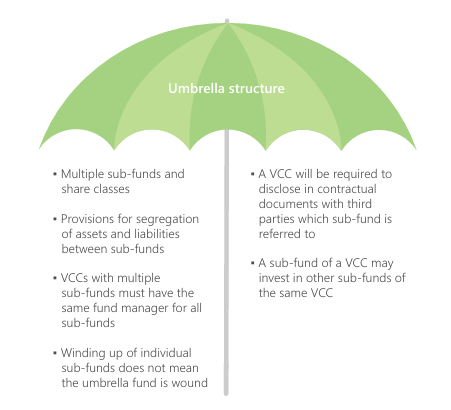
- Umbrella VCC: A single legal entity comprising multiple sub-funds, each with its own investment objectives, assets and liabilities.
The choice between these structures should reflect the fund’s investment strategy, anticipated investor base and plans for future expansion.
Why More Fund Managers and Investors Are Turning to VCCs
The appeal of a VCC lies in how it combines capital flexibility, fund segregation and a corporate structure recognised within Singapore’s established financial services environment.
1. Flexibility to accommodate different investment strategies
A fund manager may begin with one portfolio and subsequently expand into private equity, venture capital, real estate or other asset classes. Establishing a separate legal entity for every strategy can increase administrative complexity and operating costs.
An umbrella VCC provides an alternative. Multiple sub-funds can operate under one legal entity while maintaining separate assets and liabilities. Each sub-fund can have its own investment mandate and investor participation arrangements, subject to the applicable fund documentation and legal requirements.
For example: a family office may use different sub-funds to organise investments in listed securities, private companies and real estate-related assets. A fund manager may also establish separate strategies for different investor groups.
The segregation of assets and liabilities is a key statutory feature of the umbrella structure. However, it should be supported by appropriate documentation, accounting, record-keeping and operational controls.
Investors should assess whether an umbrella structure will provide genuine administrative efficiencies without creating unnecessary complexity in fund governance, investor reporting or cost allocation.
2. Greater flexibility in capital management
A conventional company structure may not accommodate the capital movements associated with investment funds as efficiently as a VCC. A VCC’s variable capital mechanism allows shares to be issued and redeemed without shareholder approval, subject to its constitution and applicable requirements. This can facilitate subscriptions and redemptions based on the fund’s net asset value (NAV), in accordance with its terms and dealing arrangements.
The structure can also distribute dividends from capital, subject to applicable legal requirements. This gives fund managers greater flexibility in managing capital and making distributions to investors.
These features can be particularly useful for funds with regular subscription and redemption activity. However, the fund’s dealing arrangements still need to reflect the liquidity of its underlying investments. For funds investing in less liquid assets, such as private equity or real estate, redemption terms, valuation policies and distribution arrangements should be carefully designed around the investment strategy.
3. A Singapore-based structure with confidentiality features
A VCC offers certain confidentiality advantages compared with a conventional Singapore company. Its register of members and financial statements are not generally available to the public through ACRA’s public portal in the same way as those of ordinary companies. This can appeal to family offices, private investment vehicles and fund managers who prefer to limit public access to information about their investors and fund arrangements.
However, confidentiality does not mean anonymity or exemption from regulatory disclosure. VCCs must maintain the prescribed registers and comply with applicable requirements concerning beneficial ownership, regulatory reporting and the provision of information to competent authorities.
4. A structure that can support long-term fund development
Singapore’s VCC framework was designed specifically for investment funds and provides a corporate structure familiar to many institutional investors and professional service providers.
The framework also permits eligible foreign corporate funds to re-domicile to Singapore, subject to the applicable requirements. This may provide an option for managers considering a transition from an existing offshore structure to a Singapore-based fund vehicle. Nevertheless, re-domiciliation should be evaluated carefully. Existing fund documentation, investor consent requirements, tax implications, regulatory approvals and contractual obligations may affect whether the transition is practical. The decision should therefore be assessed at the fund level, rather than based solely on the perceived advantages of Singapore as a jurisdiction.
What Does It Take to Establish a VCC in Singapore?
Setting up a VCC requires a fund manager, an appropriate governance structure and arrangements for meeting Singapore’s ongoing regulatory and compliance requirements. ACRA is responsible for VCC registration and corporate administration, while MAS oversees the relevant regulatory framework for fund management and anti-money laundering and countering the financing of terrorism (AML/CFT).
Each VCC must meet the applicable requirements for its directors, company secretary, auditor and fund manager. The fund manager’s regulatory status should be established early, as the proposed activities will determine whether it needs a MAS licence or can operate under an applicable exemption. Registering the VCC does not, in itself, permit its founder to carry on regulated fund management activities.
The proposed governance arrangements will also shape how the fund operates. These include the appointment of eligible directors, compliance with applicable Singapore residency requirements, investment decision-making, fund valuation, investor onboarding and reporting. Responsibilities between the VCC, its fund manager and external service providers should be clearly allocated.
For overseas founders, these requirements have practical implications for how the fund will be managed from Singapore, which local appointments are needed and what ongoing compliance costs to budget for. These arrangements should be factored into the proposed structure before incorporation.
Choosing Between a VCC and an Offshore Fund Structure
For investors considering Singapore alongside the Cayman Islands or BVI, the comparison should focus on the fund’s intended activities and long-term operating requirements rather than jurisdictional reputation alone.
Singapore may be particularly relevant for managers seeking to establish a fund within an established Asian financial centre, build relationships with regional investors and service providers, or operate alongside an existing Singapore-based fund management business.
Cayman Islands and BVI structures may remain suitable for certain international investment strategies, depending on investor expectations, transaction requirements, financing arrangements and the manager’s existing fund platform.
There is no universally superior jurisdiction. The right choice depends on the fund’s commercial purpose, investor base, regulatory obligations and total cost of operation.
How Tax Incentives Factor into VCC Structuring?
Singapore’s fund tax incentive framework is an important consideration for investors evaluating a VCC. However, the availability of tax benefits depends on the applicable scheme and the fund’s ability to meet its conditions.
Sections 13O and 13U of Singapore’s Income Tax Act are particularly relevant to eligible funds managed in Singapore. A VCC may be considered for these schemes, subject to the applicable requirements. The conditions can include requirements relating to the fund manager, qualifying investments, local business spending, investment professionals and other economic substance criteria. A VCC does not automatically qualify for tax exemption simply because it is incorporated in Singapore. Eligibility must be assessed against the fund’s activities, structure and circumstances, and relevant conditions may need to be maintained throughout the incentive period.
Family offices should pay particular attention to this distinction. The requirements applicable to a family office seeking a fund tax incentive may differ from those applicable to another investment fund. The appropriate analysis should consider the relevant scheme, the ownership and management arrangements, the investment portfolio and the resources expected to be maintained in Singapore.
Tax planning should therefore begin before incorporation. Choosing a VCC first and assessing the incentive requirements afterwards may result in a structure that does not achieve the intended outcome or requires costly changes.
Why the Structuring Decision Starts Earlier Than Most People Expect
Choosing a VCC is one of several decisions involved in establishing an investment fund. The investment strategy, investor profile, fund manager and tax position all influence how the fund should be structured. Addressing these matters early can help avoid changes to the structure after incorporation.
Before setting up a VCC, fund managers and investors should consider the following:
Define the investment and fundraising strategy: Identify the assets the fund will hold, the expected investor profile, the investment horizon and whether the fund will be open-ended or closed-ended. These factors influence the fund documentation, liquidity arrangements and choice of vehicle.
Determine the appropriate fund manager and operating model: Establish where investment decisions will be made, which entity will manage the fund and whether the proposed activities require a licence or qualify for an exemption. The fund’s governance arrangements should be consistent with its actual operations.
Assess the tax position before choosing the structure: Consider whether the fund may qualify for an applicable incentive scheme and what conditions must be satisfied. This includes assessing substance, staffing, expenditure and investment requirements where relevant.
Compare the standalone and umbrella options: An umbrella VCC may be suitable where several strategies can share a common legal and administrative framework. However, the expected savings should be weighed against the costs of maintaining separate sub-funds, accounting records, reporting and governance arrangements.
Plan for the fund’s ongoing obligations: Audit, annual filings, investor reporting, regulatory compliance, tax administration and service-provider arrangements must be factored into the operating budget from the outset.
Taken together, these decisions help determine whether a VCC is suitable, how it should be established and what needs to be in place before the fund begins operating.
Is a Singapore VCC the Right Structure for Your Fund?
A VCC can offer meaningful advantages for fund managers, family offices and investors seeking a flexible investment vehicle in Singapore. Its variable capital mechanism, umbrella structure and confidentiality features can support a range of investment strategies.
However, the decision should not be based on these features in isolation. The fund’s investment mandate, investor requirements, management arrangements, tax position and operating costs all influence whether a VCC is the appropriate choice.
For investors comparing Singapore with offshore alternatives, the most useful starting point is to define the fund’s intended operating model and assess the available structures against that objective.
At Alitium, we advise fund managers, family offices and investors on structuring and setting up investment vehicles, with support across Singapore, Vietnam and Malaysia. Our work includes assessing incorporation requirements, corporate governance, tax considerations and ongoing compliance obligations to help clients establish structures aligned with their commercial objectives.
To discuss your proposed fund structure or investment plans in Singapore, contact our team at singapore@alitium.com.
********
This article is provided for general informational purposes only and does not constitute legal, tax or professional advice. Specific tax and compliance outcomes will depend on the facts and circumstances of each case. Professional advice should be obtained before implementing or restructuring a Singapore structure. Alitium accepts no liability for actions taken in reliance on this article