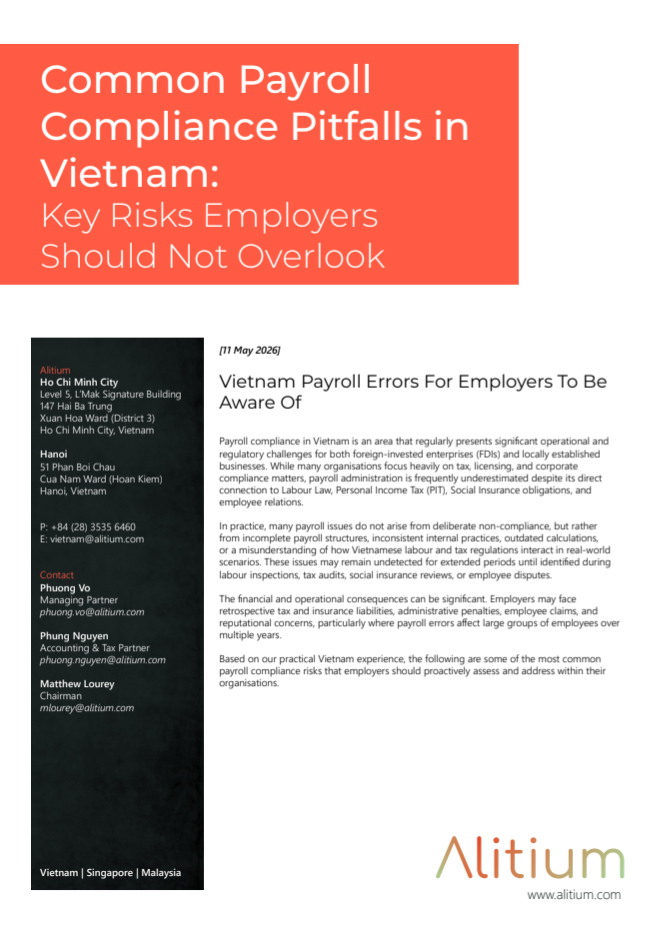
Vietnam Payroll Errors For Employers To Be Aware Of
Payroll compliance in Vietnam is an area that regularly presents significant operational and regulatory challenges for both foreign-invested enterprises (FDIs) and locally established businesses. While many organisations focus heavily on tax, licensing, and corporate compliance matters, payroll administration is frequently underestimated despite its direct connection to Labour Law, Personal Income Tax (PIT), Social Insurance obligations, and employee relations.
In practice, many payroll issues do not arise from deliberate non-compliance, but rather from incomplete payroll structures, inconsistent internal practices, outdated calculations, or a misunderstanding of how Vietnamese labour and tax regulations interact in real-world scenarios. These issues may remain undetected for extended periods until identified during labour inspections, tax audits, social insurance reviews, or employee disputes.
The financial and operational consequences can be significant. Employers may face retrospective tax and insurance liabilities, administrative penalties, employee claims, and reputational concerns, particularly where payroll errors affect large groups of employees over multiple years.
Based on our practical Vietnam experience, the following are some of the most common payroll compliance risks that employers should proactively assess and address within their organisations.
Summary of Common Payroll Compliance Risks
|
Issue Area |
Common Mistake |
Potential Risk |
Recommended Focus |
|
Regulatory Updates |
Failure to update payroll calculations following regulatory changes |
Incorrect PIT and insurance calculations, penalties and arrears |
Implement periodic payroll reviews |
|
Non-Taxable Benefits |
Applying non-taxable benefits without proper support |
Tax reassessments and audit exposure |
Maintain policies and supporting evidence |
|
Overtime & Compensation Leave |
Using compensation leave incorrectly instead of overtime payments |
Labour and payroll compliance risks |
Review labour and PIT implications |
|
Probation Arrangements |
Applying incorrect probationary payroll treatment |
Retroactive PIT and insurance liabilities |
Align treatment with contract structure |
|
Employee Terminations |
Omitting mandatory severance or final entitlements |
Employee claims and labour disputes |
Review statutory settlement obligations |
|
Policy Consistency |
Applying payroll policies inconsistently |
Audit concerns and employee distrust |
Standardise payroll procedures |
|
Salary Deductions |
Making deductions not permitted by labour law |
Administrative penalties and disputes |
Ensure lawful disciplinary processes |
|
Low Base Salary Structures |
Using unrealistic salary structures to minimise insurance costs |
Insurance reassessments and penalties |
Review remuneration structures holistically |
1. Failure to Update Payroll Calculations in Line with Regulatory Changes
Payroll calculations in Vietnam are closely linked to statutory benchmarks such as regional minimum wages, social insurance contribution caps, and tax thresholds. These benchmarks are periodically revised by the government to reflect changing economic and labour conditions.
In practice, employers do not always update payroll systems or calculation methodologies promptly following regulatory changes. This can result in incorrect social insurance contributions, inaccurate Personal Income Tax (PIT) calculations, and discrepancies in employee net remuneration. In many cases, these issues continue undetected until identified during tax audits, labour inspections, or employee queries.
Employers should therefore establish formal processes to monitor regulatory developments and ensure payroll systems, formulas, and internal controls are updated in a timely manner to reflect current legislative requirements.
2. Misapplication of Non-Taxable Benefits
The incorrect classification of non-taxable income remains one of the more common payroll compliance risks in Vietnam. While certain allowances, such as telephone, meal, or transportation benefits, may qualify for non-taxable treatment under specific conditions, those conditions are frequently misunderstood or inadequately documented.
For example, telephone allowances are often treated as non-taxable despite the absence of clear internal policies, defined eligibility criteria linked to job function, or supporting evidence demonstrating business necessity. Tax authorities may challenge these arrangements, particularly where allowance amounts appear disproportionate to salary levels or where the employee’s role does not reasonably support the benefit provided.
Failure to properly substantiate non-taxable treatment may result in retrospective tax reassessments, penalties, and interest exposure, particularly where the practice has been consistently applied across a broad employee group.
3. Incorrect Use of Compensation Leave in Lieu of Overtime Pay
Under Vietnamese labour regulations, compensation leave is generally permitted only in limited circumstances, including situations where public holidays coincide with weekly rest days. Despite this, some employers apply compensation leave as a substitute for overtime payments in order to manage labour costs or simplify payroll administration.
This approach may create both labour law and tax compliance risks. Importantly, overtime payments, if structured correctly, may qualify for preferential tax treatment, whereas compensation leave provided as a paid employment benefit is generally taxable. Incorrect implementation may therefore adversely affect both employer compliance obligations and employee entitlements.
Employers should carefully assess labour law requirements, payroll implications, and employee impacts before implementing alternative overtime arrangements or compensation structures.
4. Incorrect Tax and Insurance Treatment During Probation
A common payroll practice in Vietnam involves applying a flat 10% withholding tax and excluding employees from mandatory insurance contributions during probation periods. While this approach may be permissible under standalone probation agreements, compliance issues frequently arise where probation terms are incorporated directly into official labour contracts.
Where the labour contract term is three months or more, progressive PIT rates should generally apply and mandatory Vietnam Social Security contributions are ordinarily required. Applying probationary tax treatment under a formal labour contract structure may therefore result in retrospective tax adjustments, insurance liabilities, and administrative penalties.
This issue commonly arises where employers adopt standardised payroll practices without fully considering the legal structure of the underlying employment arrangements.
5. Omission of Mandatory Final Payments for Departing Employees
Final settlements for departing employees frequently omit statutory entitlements, particularly severance allowance obligations. A common misconception is that severance allowance only applies in employer-initiated termination scenarios. However, employees may still qualify for severance allowance upon voluntary resignation where statutory conditions are satisfied.
In practice, employers should clearly distinguish between statutory severance obligations and ex gratia or discretionary termination support payments. Failure to correctly calculate and settle mandatory entitlements may expose employers to employee claims, labour disputes, and regulatory scrutiny, particularly where the issue affects multiple departing employees over an extended period.
Careful review of termination settlements and supporting employment history is therefore critical in reducing labour compliance risk.
6. Inconsistent Application of Salary Calculation Policies
Another recurring issue involves inconsistent application of payroll policies over time. Identical scenarios may be treated differently across employees or payroll periods without any formal policy amendment or documented rationale. Common examples include overtime calculations, bonus treatment, leave deductions, and allowance calculations.
These inconsistencies often arise from manual payroll overrides, unclear policies, insufficient procedural controls, or changes in payroll personnel. Beyond compliance concerns, inconsistent payroll treatment can undermine employee confidence, create avoidable disputes, and increase audit and operational risks.
Employers should ensure payroll methodologies are properly documented, consistently applied, and periodically reviewed to support both compliance and operational transparency.
7. Salary Deductions Not Complying with Labour Laws
Vietnamese labour laws permit salary deductions only in limited circumstances prescribed by law. Employers should therefore carefully assess whether any proposed deduction is legally permissible before implementation.
In practice, some businesses impose fines or penalties directly through payroll deductions when employees breach internal company rules, rather than following the formal disciplinary procedures required under labour legislation. Such deductions are generally considered unlawful and may expose the employer to administrative penalties, employee disputes, and labour authority scrutiny.
Employers should ensure disciplinary procedures, payroll deduction practices, and internal regulations are aligned with Vietnamese labour law requirements and supported by appropriate documentation and approval processes.
8. Risks Associated with Low Base Salary Arrangements
To minimise statutory costs, particularly mandatory insurance contributions, some employers structure labour contracts with artificially low base salaries while relying heavily on allowances, incentives, commissions, or discretionary bonuses to achieve commercially realistic remuneration levels.
While commercially common in some sectors, these arrangements may create significant compliance risks where the additional payments are fixed, recurring, or guaranteed in nature. Labour and insurance authorities may determine that such payments form part of the employee’s insurable salary, potentially resulting in retrospective insurance contribution liabilities, administrative penalties, increased regulatory scrutiny, and employee disputes regarding entitlements and benefits.
These structures may also adversely affect employees’ long-term insurance-related benefits. Employers should therefore carefully review remuneration structures to ensure they are commercially supportable, operationally practical, and compliant with applicable labour and insurance regulations.
Conclusion
The issues outlined above represent only a subset of the payroll compliance challenges commonly encountered by businesses operating in Vietnam. In practice, risks may also arise across broader HR, labour, tax, and insurance administration functions, particularly where internal controls, policies, and supporting documentation are not sufficiently robust.
Given the increasing focus of Vietnamese authorities on labour, payroll, tax, and social insurance compliance, employers are encouraged to conduct periodic payroll compliance reviews, strengthen internal payroll controls and documentation processes, monitor regulatory developments on an ongoing basis, and ensure payroll practices align with both legal requirements and practical implementation realities.
A proactive and structured approach to payroll compliance not only mitigates regulatory risk, but also supports stronger governance, operational efficiency, and employee confidence.
For any further questions or assistance, please reach out to us at vietnam@alitium.com
********
This article is intended to provide an overview of recent updates and announcements. While it aims to present useful insights, it is important to note that the content shared here should not be considered as formal legal, tax or financial advice. For specific guidance on tax obligations or legal matters related to your business, we strongly recommend consulting with a qualified professional, such as a tax advisor or legal expert or directly reach out to us.