
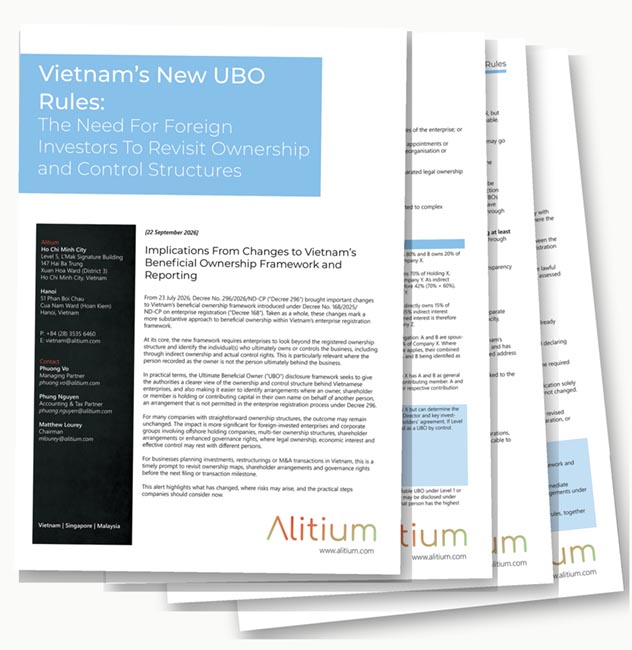
Implications From Changes to Vietnam’s Beneficial Ownership Framework and Reporting
From 23 July 2026, Decree No. 296/2026/ND-CP (“Decree 296”) brought important changes to Vietnam’s beneficial ownership framework introduced under Decree No. 168/2025/ND-CP on enterprise registration (“Decree 168”). Taken as a whole, these changes mark a more substantive approach to beneficial ownership within Vietnam’s enterprise registration framework.
At its core, the new framework requires enterprises to look beyond the registered ownership structure and identify the individual(s) who ultimately owns or controls the business, including through indirect ownership and actual control rights. This is particularly relevant where the person recorded as the owner is not the person ultimately behind the business.
In practical terms, the Ultimate Beneficial Owner (“UBO”) disclosure framework seeks to give the authorities a clearer view of the ownership and control structure behind Vietnamese enterprises, and also making it easier to identify arrangements where an owner, shareholder or member is holding or contributing capital in their own name on behalf of another person, an arrangement that is not permitted in the enterprise registration process under Decree 296.
For many companies with straightforward ownership structures, the outcome may remain unchanged. The impact is more significant for foreign-invested enterprises and corporate groups involving offshore holding companies, multi-tier ownership structures, shareholder arrangements or enhanced governance rights, where legal ownership, economic interest and effective control may rest with different persons.
For businesses planning investments, restructurings or M&A transactions in Vietnam, this is a timely prompt to revisit ownership maps, shareholder arrangements and governance rights before the next filing or transaction milestone.
This alert highlights what has changed, where risks may arise, and the practical steps companies should consider now.
1. Who is a UBO under the New Framework?
Before Decree 296, the identification exercise under Decree 168 broadly rested on two tests:
- an individual directly or indirectly owning at least 25% of the charter capital or 25% of the total voting shares of the enterprise; or
- an individual having the power to control the adoption of specified material corporate decisions, including appointments or removals of management personnel, amendments to the charter, changes to the management structure, reorganisation or dissolution.
This was less clear for layered or dispersed ownership structures, or where contractual and governance rights separated legal ownership from effective control.
A more structured identification sequence under Decree 296
Decree 296 keeps the Decree 168 framework but makes the identification process more structured and better suited to complex ownership and control arrangements.
The revised framework can be summarised as follows:
Level | Identification criteria | Illustrations |
Level 1 – Ownership |
|
|
Level 2 – Subtantive Control | Where an individual does not satisfy the ownership criteria under Level 1, or if the individual identified under Level 1 does not reflect the actual UBO, the enterprise must assess control rights, including the power to:
| A owns only 5% of Company X but can determine the appointment of the General Director and key investment policies under a shareholders’ agreement. If Level 2 applies, A may be identified as a UBO by control. |
Level 3 – Fallback management disclosure | If no individual is identified under Level 1 or Level 2, the enterprise discloses the individual with the highest managerial authority to act on its behalf. | If Company X has no identifiable UBO under Level 1 or Level 2, its General Director may be disclosed under the fallback mechanism if that person has the highest managerial authority. |
What has changed in substance under the revised mechanism?
- First, the identification process is now expressly sequential. Decree 168 already recognised both ownership and control, but Decree 296 places those criteria within a defined order of analysis, rather than treating them as concurrent or interchangeable.
- Second, the ownership analysis is broader. Decree 296 expressly covers combined direct and indirect interests, multiple ownership chains, and aggregation in specified family or contractual arrangements. For multi-tier structures, the analysis may go beyond the immediate shareholder on record.
- Third, Decree 296 introduces a fallback disclosure mechanism. Where ownership and control do not identify a UBO, the enterprise discloses the individual with the highest managerial authority.
However, it remains unclear whether this individual is intended to be treated as a UBO or simply as a person required to be disclosed as a fallback. The new UBO declaration form may support the latter interpretation, as it provides a separate section for the individual with the highest managerial authority, rather than including this individual among those identified as UBOs through ownership or control. However, this is not merely a disclosure matter, as treating this individual as a UBO may have practical implications for the individual, as discussed further in Item 2 below. This point will need to be further clarified through guidance and practice from the competent authorities.
- Finally, the previous standalone requirement for joint stock companies to disclose corporate shareholders holding at least 25% of the total voting shares has been removed. The revised approach instead places greater emphasis on tracing through the ownership and control structure to identify the relevant individual.
Overall, Decree 296 makes the UBO analysis more structured, substantive and aligned with Vietnam’s beneficial ownership transparency agenda.
2. Implications for individuals identified as UBOs
Being identified as a UBO does not, in itself, make an individual responsible for the obligations of the enterprise or create a separate category of tax, corporate or management liability. Any such liability must arise independently from the individual’s legal capacity, conduct or obligations under the applicable law.
UBO status may still trigger regulatory consequences linked to the enterprise’s compliance position. For example, under Vietnam’s tax administration rules, a UBO may be subject to temporary exit suspension where their enterprise is under tax enforcement and has overdue tax liabilities of at least VND 500 million for 120 days or more, or where the enterprise is not operating at its registered address and the issue remains unresolved after the statutory period.
In short, UBO status does not transfer enterprise liabilities to the individual, but it may expose that individual to measures linked to the enterprise’s own compliance issues.
3. Administrative penalties for UBO-related non-compliance
The revised UBO framework is supported by a more detailed enforcement regime.
Decree No. 288/2026/ND-CP supplements the enterprise registration penalty framework with sanctions for inaccurate declarations, late or missing updates, failures to provide information upon request, and record-keeping breaches. The key penalties applicable to enterprises include:
# | Violation | Potential fine |
1. | Providing false or inaccurate UBO information | VND 30–70 million |
2. | Late notification of changes to UBO information | Warning to VND 60 million |
3. | Failure to notify changes to UBO information | VND 30–70 million |
4. | Failure to declare UBO information upon incorporation | VND 50–100 million |
5. | Failure by a pre-1 July 2025 enterprise to supplement UBO information at the relevant subsequent filing | VND 70–100 million |
6. | Providing incomplete information or failing to provide information within the prescribed time following a competent authority’s request | VND 20–30 million |
7. | Failure to provide information, or providing false or inaccurate information, following a competent authority’s request | VND 50–70 million |
8. | Failure to maintain the required UBO list | VND 40–70 million |
Corrective measures may also require the enterprise to make, amend or resubmit the relevant declaration or report.
4. UBO transparency and capital contributions made in another person’s name
Decree 296 also introduces a new principle for enterprise registration, requiring owners, members and shareholders to comply with the rules on capital contributions and not to be named as contributing capital on behalf of another person. This is relevant where the person recorded as the owner, member or shareholder differs from the person who in fact provides the capital.
The revised UBO regime may make nominal ownership or back-to-back funding arrangements more visible. A mismatch between the registered shareholder and the individual identified through the UBO analysis may invite closer scrutiny during enterprise registration review.
However, Decree 296 does not state that every such arrangement is automatically invalid, that the actual funder becomes the lawful owner, or that a standalone sanction applies to the arrangement itself. The consequences remain fact-specific and should be assessed against the transaction documents, enterprise records and applicable laws.
5. Timing for UBO filings under the revised framework
Decree 296 took effect on 23 July 2026, but the practical filing implications differ depending on whether an enterprise has already declared its UBO information.
- Enterprises incorporated on or after 23 July 2026 must apply the revised Decree 296 criteria when identifying and declaring their UBOs as part of the incorporation process.
- Enterprises established before that date but which have not yet declared UBO information must supplement the required information at the next relevant enterprise registration filing, applying the Decree 296 criteria then in force.
- Enterprises that had already declared UBO information under Decree 168 are not required to make a fresh notification solely because Decree 296 revised the identification methodology, provided that the information previously declared has not changed. This position has been expressly confirmed by the Ministry of Finance in response to an enterprise enquiry.
Accordingly, existing enterprises are not required to re-file UBO information merely because Decree 296 has introduced a revised identification methodology. A fresh filing would only be relevant where the enterprise has not yet made the required declaration, or where the previously declared information has changed.
What businesses should do now
- Reassess their existing UBO position: Businesses should reassess their existing UBO analysis under the revised framework and determine whether any filing or update is required in light of the applicable timing rules.
Particular attention should be given to structures where ownership or control is not readily apparent from the immediate corporate records, including multi-tier ownership chains, interests held across related family members, and arrangements under which voting, appointment or other governance rights do not track the underlying equity interest.
- Maintain appropriate UBO records: Businesses should maintain the UBO records required under the applicable rules, together with sufficient supporting information to substantiate the basis on which each UBO has been identified.
- Consider UBO implications in M&A and restructuring: In M&A and restructuring transactions, UBO considerations should be addressed as part of legal due diligence, transaction structuring and post-closing implementation. The analysis should extend beyond the direct member or shareholder on record to the wider ownership chain and relevant governance arrangements that may affect ultimate ownership or control.
Need support assessing your UBO position? Our team can help review ownership chains, governance arrangements and upcoming filing obligations, and identify practical actions before your next enterprise registration, restructuring or transaction filing.
For any further questions you may have, please reach out to us at vietnam@alitium.com
********
This article is intended to provide an overview of recent updates and announcements. While it aims to present useful insights, it is important to note that the content shared here should not be considered as formal legal, tax or financial advice. For specific guidance on tax obligations or legal matters related to your business, we strongly recommend consulting with a qualified professional, such as a tax advisor or legal expert or directly reach out to us.