Malaysia Budget 2027 and Opportunities For Regional Expansion
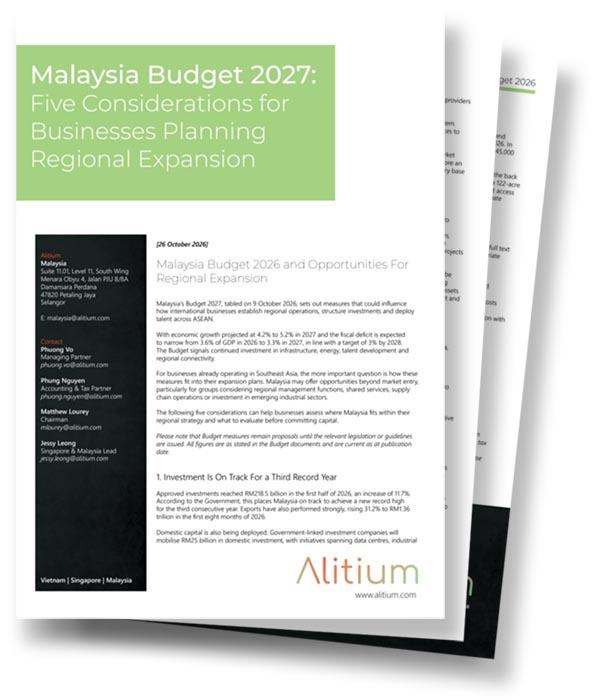
Malaysia’s Budget 2027, tabled on 9 October 2026, sets out measures that could influence how international businesses establish regional operations, structure investments and deploy talent across ASEAN.
With economic growth projected at 4.2% to 5.2% in 2027 and the fiscal deficit is expected to narrow from 3.6% of GDP in 2026 to 3.3% in 2027, in line with a target of 3% by 2028. The Budget signals continued investment in infrastructure, energy, talent development and regional connectivity.
For businesses already operating in Southeast Asia, the more important question is how these measures fit into their expansion plans. Malaysia may offer opportunities beyond market entry, particularly for groups considering regional management functions, shared services, supply chain operations or investment in emerging industrial sectors.
The following five considerations can help businesses assess where Malaysia fits within their regional strategy and what to evaluate before committing capital.
Please note that Budget measures remain proposals until the relevant legislation or guidelines are issued. All figures are as stated in the Budget documents and are current as at publication date.
1. Investment Is On Track For a Third Record Year
Approved investments reached RM218.5 billion in the first half of 2026, an increase of 11.7%. According to the Government, this places Malaysia on track to achieve a new record high for the third consecutive year. Exports have also performed strongly, rising 31.2% to RM1.36 trillion in the first eight months of 2026.
Domestic capital is also being deployed. Government-linked investment companies will mobilise RM25 billion in domestic investment, with initiatives spanning data centres, industrial logistics and semiconductors. As foreign and domestic capital flows into these industries, we anticipate that suppliers, service providers and potential co-investors will follow, creating a broader ecosystem for new entrants to build on.
Companies planning to enter Malaysia should assess where their products or services fit within the existing investment ecosystem. Opportunities may arise through supplying established investors, partnering with local businesses or providing specialist services to expanding industrial operations.
However, strong investment figures do not automatically translate into commercially viable opportunities for every entrant. Market demand, customer concentration, local competition, operating costs and access to suitable partners should all be assessed before an investment decision is made. For businesses already operating elsewhere in ASEAN, Malaysia may also provide a complementary base for serving regional customers or diversifying their supply chains.
2. Power And Green Investment Are Scaling Up
Malaysia has remained resilient against the impact of the Middle East conflict, but the energy transition must now be expedited to secure the long-term sustainability of the nation’s energy supply. To this end, Tenaga Nasional Berhad (TNB), the national utility, will invest RM15 billion to strengthen the national grid, while UEM Lestra, a company set up to develop Malaysia’s green industries, including renewable energy, will invest RM1 billion in projects such as energy storage at Kuala Lumpur International Airport and a 1-gigawatt hybrid energy project in Johor. At a regional level, PETRONAS and TNB are also participating in cross-border energy projects under the ASEAN Power Grid.
Green investment is also supported through the tax system. Tax incentives for green and sustainable technology are proposed to be enhanced and extended until 31 December 2030, including an Investment Tax Allowance of up to 100% for companies undertaking green and sustainable technology projects or electric vehicle charging stations, and for companies purchasing green technology assets for their own consumption. These measures are aimed at keeping Malaysia’s power supply reliable through the Middle East conflict and the very strong El Niño expected to bring extreme heat in early 2027.
3. A Regional Hub Can Be Planned For Up To 30 Years
The Global Services Hub (GSH) incentive is intended for companies that run a group’s regional business management from Malaysia, together with at least two other services, such as shared services or treasury. It is proposed to be enhanced for applications from 1 January 2027, with the following key features:
- a preferential corporate tax rate of 5% on qualifying income for new GSH companies;
- an incentive period granted in five-year blocks, for up to 30 years, subject to performance; and
- for GSH companies that pool group cash through onshore intermediaries, exemptions from withholding tax on interest paid to non-residents and from stamp duty on foreign-currency intercompany loan agreements. These exemptions will also apply to such activities under the Johor-Singapore Special Economic Zone (JS-SEZ) package.
This incentive horizon of up to 30 years allows a group to plan its regional hub over the long term, rather than around a single incentive cycle.
4. Talent You Can Move, And Talent You Can Hire
From 1 January 2027, spouses of expatriates holding a Category I Employment Pass (the top category, which since 1 June 2026 requires a minimum salary of RM20,000 a month) will be permitted to work in Malaysia while on a Dependant Pass, subject to conditions to be prescribed.
On the local front, the Budget allocates RM8 billion across ministries to technical and vocational education and training, and HRD Corp will offer 3 million training opportunities, including continuing professional development. AI Malaysia Berhad will also receive funding to work towards a target of 200,000 AI-skilled workers.
The Budget also seeks to link wages more closely to productivity. The minimum wage will increase to RM2,000 a month from June 2027, with an exemption for micro, small and medium enterprises with annual sales below RM50 million. The Government also plans to introduce a minimum wage of RM2,500 a month for semi-skilled workers and graduates.
Talent sourcing and deployment are often the most challenging part of a regional expansion. These measures make it easier to relocate senior leaders and their families, while investing in the local talent pool from which businesses will recruit.
5. Borders Are Becoming Gateways
In the south, the JS-SEZ recorded RM132 billion in investment between 2025 and June 2026. The Prime Ministers of Malaysia and Singapore, Anwar Ibrahim and Lawrence Wong, are expected to launch the JS-SEZ Master Plan and Blueprint by the end of 2026. In addition, a new industrial node at Nexus Sedenak, in the north of the JS-SEZ, carries potential investment of RM12 billion and 45,000 jobs.
In the north, trade along the Bukit Kayu Hitam–Sadao corridor with Thailand reached RM27 billion in the first half of 2026. On the back of this, the Delapan Special Border Economic Zone will continue to be strengthened. Developments include NCT InnoSphere, a 122-acre hub for heavy vehicles, engineering, maintenance and logistics that will complement industries in Kulim and Penang, and direct access from the East Gate of the Bukit Kayu Hitam Immigration Complex to the Inland Container Depot, to be developed through private investment to speed up cargo movement.
Before committing to an investment
Most of these measures still require legislation or detailed guidelines before they take effect. The Budget speech notes that the full text and its annexes, as circulated, are authoritative. Budget 2027 presents several developments worth considering, but the appropriate response will depend on each company’s commercial objectives, existing regional footprint and investment timeline.
Before establishing or expanding operations in Malaysia, businesses should consider the following steps:
- Define the operating model: Determine whether the objective is local market access, manufacturing, distribution, shared services, treasury or a broader regional management function.
- Compare locations on commercial grounds: Evaluate customer access, infrastructure, workforce availability, operating costs and supply chain requirements alongside available incentives.
- Validate the tax position: Review eligibility, approval requirements, qualifying income, incentive periods and the interaction with the group’s wider tax structure.
- Review the legal and compliance requirements: Confirm the appropriate entity and licensing structure, employment obligations, reporting requirements and any cross-border implications.
- Build a realistic implementation timeline: Distinguish between announced measures, proposals awaiting legislation and incentives for which detailed guidelines or approvals are required.
For any further questions you may have, please reach out to us at malaysia@alitium.com
********
This article is intended for general information purposes only and does not constitute legal, tax or other professional advice. It is not intended to be comprehensive and should not be relied upon as a substitute for advice specific to your circumstances. The information contained in this publication is based on sources believed to be reliable and is current as at the date of publication. Laws, regulations, tax rates, regulatory requirements and administrative practices may change, and the information may therefore become outdated. Alitium accepts no responsibility for any loss or liability arising from any action taken or not taken in reliance on this publication. Please seek specific professional advice before making any legal, tax, structural or investment decisions.