
2026 Updates: Employment of Foreign Talent in Singapore and Malaysia
When businesses discuss regional expansion or restructuring in ASEAN, Singapore and Malaysia are often at the top of the list. Both offer political stability, mature regulatory environments and well-established ecosystems for international businesses, making them attractive destinations for regional headquarters and cross-border talent.
In 2026, both jurisdictions significantly reshaped their foreign employment frameworks. Singapore continues to refine a merit-based system that prioritises high-value talent and workforce quality, while Malaysia has introduced a more structured framework with clearer salary bands, defined employment tenures and greater emphasis on workforce localisation.
For businesses hiring across Southeast Asia, these changes will affect workforce planning, remuneration strategies, regional mobility and long-term talent allocation. Assumptions that previously applied across both markets may no longer hold.
This article compares the latest work pass frameworks in Singapore and Malaysia, outlining the key regulatory changes, practical differences and considerations for employers.
At a Glance
Singapore (MOM) | Malaysia (ESD / MIDA) | |
Governing update | COMPASS (ongoing since 2023); salary floors reset for 2026, again from 2027 | NEEP 2026, effective 1 June 2026, first full revision since 2016 |
Salary | EP from S$5,600, age-scaled to S$10,700+; S Pass from S$3,300 | Category III from RM5,000; Category I from RM20,000, flat by category |
Duration | No fixed total cap; renewed on continued eligibility | Hard cap: 10 years (Cat I & II), 5 years (Cat III) |
Dependants | Eligible above S$6,000 fixed salary (EP) | Eligible across all three categories from 1 June 2026 |
Employer obligations | S Pass levy S$650/month; no levy on EP; FCF job advertising | Basic-salary-only threshold; no disclosed levy in current framework |
Quota | S Pass capped at 10–15% of workforce | No fixed workforce quota by category |
Succession planning | Not formally required; COMPASS rewards local PMET share instead | Mandatory for Category II and III |
Government philosophy | Merit-and-salary filter: pay enough, score enough, stay | Tiered and time-limited: qualify by salary, localise on a clock |
Source: Compiled from MOM and MIDA published guidance.
What Has Changed in Singapore
Singapore issues two main passes below director or specialist-investor level:
- the Employment Pass (EP) for managers, executives and specialists, and
- the S Pass for mid-skilled roles.
Employment Pass: a two-stage test
To qualify for an Employment Pass (EP), applicants must satisfy a two-stage assessment.
First, the applicant must meet the minimum qualifying salary, which is age-adjusted. Only candidates who satisfy this salary threshold can proceed to the second stage.
The application is then assessed under the Complementarity Assessment Framework (COMPASS), Singapore’s points-based system that evaluates factors including salary competitiveness, qualifications, workforce diversity, support for local employment, and bonus criteria such as recognised shortage occupations. Applicants must achieve at least 40 COMPASS points to qualify.
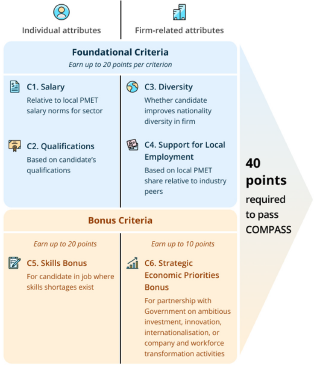
(Source MOM.Gov.SG)
Qualifying salary (from July 2026)
- S$5,600 per month for most sectors
- S$6,200 per month for the financial services sector
The minimum salary increases progressively with age, reaching S$10,700 (most sectors) and S$11,800 (financial services) for applicants aged 45 and above.
The Ministry of Manpower (MOM) has also announced higher qualifying salary thresholds from 1 January 2027 for new EP applications and 1 January 2028 for renewals. The minimum salaries will increase to S$6,000 (most sectors) and S$6,600 (financial services), rising to S$11,500 and S$12,700 respectively for applicants aged 45 and above.
Businesses planning future recruitment or multi-year workforce expansion should factor these higher salary thresholds into their hiring budgets, particularly where Employment Pass renewals will fall due from 2028.
S Pass: quota and levy
The S Pass is intended for mid-skilled foreign employees and is subject to salary, quota and levy requirements.
Qualifying salary (from July 2026)
- S$3,300 per month for most sectors
- S$3,800 per month for the financial services sector
The qualifying salary is age-adjusted and will increase to S$3,600 and S$4,000 respectively from 1 January 2027.
Unlike the Employment Pass, S Pass holders are subject to a Dependency Ratio Ceiling (DRC) of 10% in the services sector and up to 15% in other sectors, together with a monthly levy of S$650 per pass holder.
From 1 July 2026, the Local Qualifying Salary (LQS) increased to S$1,800 per month, meaning local employees must earn at least this amount to be counted towards an employer’s quota. This reduces the available capacity for S Pass and Work Permit holders unless employers maintain sufficient qualifying local employment.
What this means in practice
Singapore’s work pass framework rewards employers that offer competitive, age-appropriate salaries and maintain a diverse, locally supported workforce. In return, Employment Passes are not subject to a maximum period of stay, provided the eligibility criteria continue to be met.
The trade-off is a higher level of compliance. Employers must satisfy the COMPASS framework, comply with Fair Consideration Framework (FCF) advertising requirements where applicable, and, for S Pass holders, manage workforce quotas and levy obligations alongside ongoing workforce planning.
What Has Changed in Malaysia
Malaysia’s New Expatriate Employment Policy (NEEP) 2026, approved by Cabinet on 17 October 2025 and effective from 1 June 2026, is the first major overhaul of the country’s Employment Pass framework since 2016. It introduces three salary-based categories, together with a maximum employment tenure and mandatory succession planning for certain expatriate roles.
Three Employment Pass Categories
Category | Minimum basic salary | Max. tenure | Succession plan |
Category I | RM20,000 and above | Up to 10 years | Not required |
Category II | RM10,000 – RM19,999 | Up to 10 years | Required |
Category III | RM5,000 – RM9,999 (RM7,000+ manufacturing) | Up to 5 years | Required |
Source: MIDA and Malaysia’s Ministry of Home Affairs, effective 1 June 2026.
The category is set by basic salary alone. Housing, transport, bonuses and other allowances are excluded, meaning a remuneration package that appears competitive on total compensation may still fall below the qualifying threshold if the basic salary is set too low.
Succession planning is now a filing requirement
Category II and III sponsorships must document how the role will eventually transfer to a Malaysian employee. While this was previously encouraged as good practice, NEEP makes it a formal application requirement. Category I pass holders, typically senior executives and specialised experts, are exempt.
Filing channel: MIDA or ESD
Since 16 March 2026, manufacturing and selected services companies under MIDA’s purview file through the MIDA Expatriate System (MES), while all other sectors continue to apply through the Expatriate Services Division (ESD). Confirming the correct filing channel before preparing an application can help avoid unnecessary delays.
Dependants now cover all three categories
From 1 June 2026, dependants (spouse, children, parents, and a foreign domestic helper) have also been expanded to cover three Employment Pass categories, including Category III for the first time. In addition, spouses of Category I pass holders may apply for employment in Malaysia.
Looking Ahead: Which jurisdiction best supports your hiring strategy?
The right choice depends less on the work pass itself and more on the role you are hiring for.
Singapore is generally better suited to regional leadership and long-term specialist roles, where continuity is important and there is no fixed maximum period of stay. Malaysia, by contrast, is often a stronger fit for project-based, technical or manufacturing roles with a defined business lifecycle.
For many businesses expanding into Southeast Asia, the most effective approach is not choosing one jurisdiction over the other but using each where it adds the greatest value. Both Singapore and Malaysia have moved beyond treating work passes as immigration tools alone. Increasingly, they are using them to attract high-value talent while strengthening local capability. As a result, work pass planning should be considered alongside corporate structuring, tax and operational planning rather than as a standalone immigration exercise.
At Alitium, we help international businesses develop workforce strategies that align with their regional expansion plans, providing practical advice on market entry, work pass planning and ongoing compliance across Singapore, Malaysia and Vietnam.
SOURCES
- Ministry of Manpower Singapore, “Eligibility for Employment Pass”, mom.gov.sg/passes-and-permits/employment-pass/eligibility, page last updated 28 April 2026.
- Ministry of Manpower Singapore, S Pass qualifying salary and levy guidance, mom.gov.sg/passes-and-permits/s-pass.
- MIDA, “Announcement: Implementation of New Expatriate Employment Policy”, mida.gov.my/media-release, published February 2026.
- Malaysia Ministry of Home Affairs (MOHA), announcement of revised Employment Pass salary thresholds effective 1 June 2026, issued 14 January 2026 following Cabinet approval on 17 October 2025.
- Immigration Department of Malaysia, Expatriate Services Division (ESD), esd.imi.gov.my
For any further questions or assistance, please reach out to us at contact@alitium.com
********
This article is provided for general informational purposes only and does not constitute legal, tax, immigration or professional advice. Salary thresholds, categories and policy requirements referenced above are current as at 31 July 2026 and are subject to change by the Ministry of Manpower (Singapore), the Ministry of Home Affairs (Malaysia) and the Malaysian Investment Development Authority. Readers should verify current requirements directly with the relevant authority or seek independent professional advice before making hiring or immigration decisions. Alitium accepts no liability for actions taken in reliance on this article.