
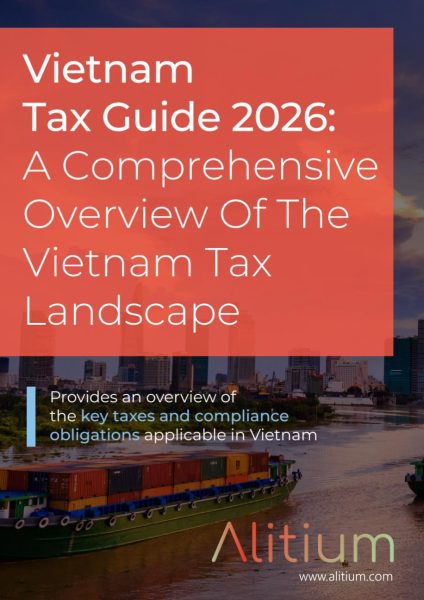
2026 Tax Guide for Vietnam
Vietnam’s tax rules are evolving at pace. New guidance is issued regularly, compliance expectations continue to rise, and tax authorities are taking an increasingly sophisticated approach to audits and enforcement. For businesses, keeping up is about understanding how the rules apply in practice and making informed decisions before issues arise.
Whether you are entering the Vietnamese market, expanding an existing business or managing regional operations, a clear understanding of Vietnam’s tax landscape is essential to reducing risk and supporting sustainable growth.
Alitium’s Vietnam Tax Guide 2026 provides practical insights into Vietnam’s tax system, helping foreign investors, multinational groups and growing businesses navigate key areas including corporate income tax, value-added tax, personal income tax, transfer pricing, the Global Minimum Tax and ongoing compliance obligations. Written by experienced tax professionals, the guide explains complex regulations in clear, commercially focused language to support informed business decisions.
Why Vietnam’s Tax Environment Demands Closer Attention
Vietnam’s tax framework has matured considerably over the past few years. Authorities have invested in digital tax administration, expanded data-matching capabilities across customs, banking and invoicing systems, and tightened enforcement around related-party transactions. For businesses, this means fewer blind spots and less tolerance for inconsistent reporting.
At the same time, the regulatory environment continues to evolve through new decrees, circulars and reform packages, including ongoing changes under Resolution 66 and updates to transfer pricing guidance. Staying ahead requires more than reacting to filing deadlines; it requires structuring operations with the next round of changes in mind.
Who This Guide Is For
This resource is designed for:
- Foreign investors entering Vietnam
- Regional finance and tax teams
- CFOs and Finance Directors
- HR and Payroll professionals
- Multinational groups
- SMEs expanding into Vietnam
What This Guide Covers
Our Vietnam Tax Guide 2026 brings together practical insights from Alitium’s tax and accounting experts to understand before, during and after market entry:
1. Key Vietnam Tax Updates in 2026
A summary of the most significant legislative changes taking effect this year, including the revised Corporate Income Tax Law, Special Consumption Tax reform under Law No. 66/2025/QH15, the rollout of the Global Minimum Tax regime, expanded transfer pricing audits, and continued growth of Extended Producer Responsibility obligations.
2. Corporate Income Tax (CIT)
An overview of Vietnam’s CIT framework, including standard and preferential rates, deductible and non-deductible expenses, tax incentives for priority sectors and locations, tax-exempt income categories, loss carry-forward rules, and the CIT calculation methodology.
3. Value Added Tax (VAT)
Guidance on VAT calculation methods, applicable rates, conditions for the 0% export rate, declaration and payment deadlines, refund mechanisms, and e-invoicing requirements, along with common compliance pitfalls businesses encounter when registering and reporting VAT in Vietnam.
4. Personal Income Tax (PIT)
An explanation of how tax residency status determines PIT liability, the simplified progressive tax brackets, updated personal and dependent deductions, PIT-exempt income categories, and the annual declaration and finalisation timeline for both employers and employees.
5. Transfer Pricing (TP)
Practical explanation of Vietnam’s transfer pricing rules under Decree 132, including the arm’s length principle, related-party transaction thresholds, accepted TP methods, documentation requirements, exemption conditions, and interest deductibility limits.
6. Minimum Global Tax (Pillar 2)
An overview of Vietnam’s implementation of the OECD Global Anti-Base Erosion rules, covering the Qualified Domestic Minimum Top-up Tax (QDMTT), the Income Inclusion Rule (IIR), effective tax rate calculations, and key compliance deadlines for in-scope multinational groups.
7. Double Taxation Agreements (DTAs)
Guidance on how Vietnam’s extensive DTA network reduces withholding tax exposure on cross-border payments, the conditions for applying treaty benefits, and the documentation required to support a Certificate of Tax Residence claim.
8. Special Consumption Tax (SCT)
A summary of applicable SCT rates across goods and services, including the phased increases for tobacco, alcohol, motor vehicles and newly captured categories such as sugar-sweetened beverages, along with available tax credits for raw material inputs.
9. Financial Responsibility for the Environment Fund
An overview of Extended Producer Responsibility obligations, including financial contributions for product and packaging recycling, waste treatment contributions for hazardous or hard-to-recycle products, applicable exemptions, and key compliance deadlines.
What Businesses Should Do Now
Given the pace of regulatory change, businesses operating in or entering Vietnam should avoid a reactive, filing-by-filing approach to tax compliance. Instead, consider:
- Reviewing current CIT positions against revised incentive eligibility, loss offset rules and the broadened Permanent Establishment concept
- Assessing whether related-party transactions and intercompany arrangements meet transfer pricing documentation thresholds
- Confirming whether the group falls within scope of Vietnam’s Global Minimum Tax (Pillar 2) obligations
- Reviewing employee compensation structures against the simplified PIT brackets and updated deductions
- Checking whether cross-border payments qualify for reduced withholding tax under an applicable Double Taxation Agreement
- Engaging a local advisor before, not after, issues are raised by tax authorities
How Alitium Can Help
Alitium supports foreign investors, multinational groups and growing businesses across Vietnam, Singapore and Malaysia with tax advisory, compliance and accounting services. Our team works closely with finance leaders to translate complex regulatory requirements into clear, practical guidance, helping businesses stay compliant while making informed, commercially sound decisions.
If you would like to discuss how Vietnam’s 2026 tax changes may affect your business, our team is ready to assist. Reach out to us at vietnam@alitium.com.
*******************
This guide is intended to provide an overview of recent updates and announcements. While it aims to present useful insights, it is important to note that the content shared here should not be considered as formal legal, tax or financial advice. For specific guidance on tax obligations or legal matters related to your business, we strongly recommend consulting with a qualified professional, such as a tax advisor or legal expert, or directly reach out to us.