
Vietnam Tax Audits in 2026: What Businesses Need to Know About Inspection Risks
In March 2026, Vietnam’s Department of Taxation issued Official Letter No. 1927/CT-KTr, identifying 302 enterprises selected for specialised tax review based on structured risk assessment criteria.
While the letter relates to a specific group of businesses, its broader significance lies in what it reveals about the tax authority’s current risk methodology. The criteria used to select these enterprises, together with the audit areas highlighted, provide a clear indication of the matters likely to attract increased scrutiny in future tax inspections and audits.
For businesses operating in Vietnam, the letter is a useful reference point for reviewing tax governance, documentation practices and transfer pricing positions, particularly where a company reports sustained losses, low profitability, or significant related-party transactions.
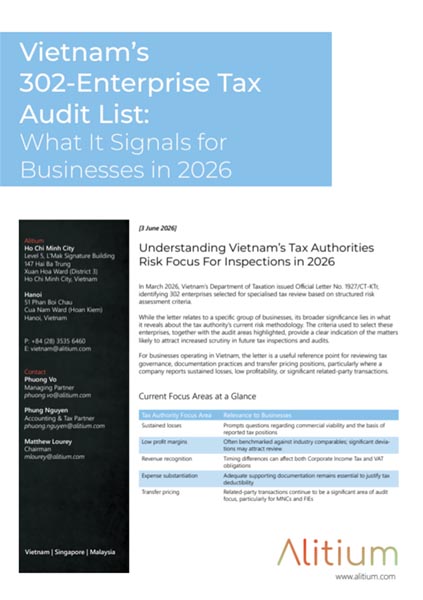
Current Focus Areas at a Glance
|
Tax Authority Focus Area |
Relevance to Businesses |
|
Sustained losses |
Prompts questions regarding commercial viability and the basis of reported tax positions |
|
Low profit margins |
Often benchmarked against industry comparables; significant deviations may attract review |
|
Revenue recognition |
Timing differences can affect both Corporate Income Tax and VAT obligations |
|
Expense substantiation |
Adequate supporting documentation remains essential to justify tax deductibility |
|
Transfer pricing |
Related-party transactions continue to be a significant area of audit focus, particularly for MNCs and FIEs
|
Risk Indicators on the Tax Authority’s Radar
The Department of Taxation has reiterated a number of factors that may increase the likelihood of a taxpayer being selected for further review. These indicators do not automatically imply non-compliance, but rather form part of the risk assessment framework used to allocate audit and inspection resources.
Understanding which indicators are in focus allows businesses to assess their own profile objectively and to ensure that positions which may attract scrutiny are appropriately documented and commercially supported.
Sustained Losses Over Multiple Years
Businesses reporting losses over an extended period remain a consistent focus for the tax authorities. While sustained losses are often commercially justifiable, particularly during periods of investment, market entry or external disruption, they may nonetheless prompt enquiries regarding the underlying business model and the tax positions adopted. Consecutive years of losses are treated as a systemic flag that often triggers a formal obligation for tax authorities to seek explanation.
Persistently Low Profitability
Companies generating profits that are consistently low relative to the scale of their operations may attract attention. The tax authorities will typically seek to understand the commercial factors contributing to this profitability profile and assess whether reported results are consistent with the nature and scale of business activities.
This indicator is particularly relevant for businesses that operate within larger corporate groups, where internal pricing arrangements, cost allocations or funding structures may have a material influence on the profitability reported in Vietnam.
Profit Margins Materially Below Industry Averages
Businesses whose profit margins remain significantly below industry norms over multiple consecutive years may be subject to additional review. Benchmarking against sector performance has long been a component of the tax authority’s risk framework, particularly for foreign-invested enterprises and multinational groups. This approach draws on increasingly sophisticated data analytics capabilities being deployed by the tax authority.
Where a business has a credible commercial explanation for below-average margins, that explanation should be documented clearly and consistently across financial statements, transfer pricing records and any related-party disclosures.
What the Audit Program Is Examining
The review program commenced in April 2026 and is expected to continue through December 2026. While the focus has been described as a specialised audit campaign, the areas under examination reflect broader enforcement priorities that will shape tax inspections well beyond this cycle.
The four areas outlined below are not isolated topics, and have been key areas that the tax authorities have focused on for some time. In practice, they are closely connected, and findings in one area will often prompt further investigation in another. Businesses should consider their exposure across all four areas rather than focusing on any single category in isolation.
Related-Party Transactions and Transfer Pricing
Transfer pricing and related-party arrangements remain the most prominent area of audit focus, particularly for multinational groups and foreign-invested enterprises. Specific areas under review include intercompany service fees and management charges, royalty and trademark arrangements, regional cost allocations and shared services, and intercompany financing and interest expenses, including thin capitalisation.
For businesses with cross-border structures, the ability to demonstrate economic substance, and not just legal form, behind these arrangements is increasingly important. The tax authority is paying close attention to whether the commercial reality of intercompany arrangements is consistent with how they are documented and priced.
Revenue, Expense and Profitability Analysis
Tax authorities are analysing trends in revenue, expenses and profitability, with particular attention given to material or unusual transactions and significant fluctuations between reporting periods. The objective is to assess whether reported financial results reflect the genuine economic reality of the business, with inspectors cross-referencing revenue movements against cost structures and isolating significant or anomalous expenditure items.
Revenue Recognition and VAT Timing
The timing of revenue recognition remains a recurring area of review. Authorities are examining whether revenue and associated VAT obligations have been recorded in the appropriate reporting period, and whether accounting treatment is supported by underlying documentation and contractual arrangements. Artificial delays in revenue recognition to reduce current-period tax obligations are a specific focus.
Businesses with long-term contracts, milestone-based billing arrangements, or complex delivery structures should ensure that their revenue recognition policies are clearly documented and applied consistently.
Business Expense Substantiation
Significant operating expenses, including cost of goods sold, administrative expenditure, selling costs and other deductions claimed for tax purposes, are subject to scrutiny. The focus is on whether costs are adequately documented, commercially justifiable and incurred for legitimate business purposes. Documentation deficiencies, rather than the nature of the expense itself, are often the basis on which deductions are challenged.
Businesses should review whether their current filing and archiving practices are sufficient to support deductions in the event of a formal audit, paying particular attention to expenses that are large in value, unusual in nature, or paid to related parties.
Understanding the Scope: Beyond the 302 Named Enterprises
It would be erroneous to simply check whether a company appears on the list and, finding it does not, conclude there is no immediate concern. This misreads the letter’s significance.
Official Letter 1927 is not a static, one-time list. The Department of Taxation has directed local tax departments to continuously update risk assessments using 2025 tax finalisation data and advanced data analytics. Businesses should treat the 302-enterprise list as an illustration of current audit priorities and risk methodology, not as a closed group of taxpayers subject to review.
As the tax authority’s analytical capabilities expand, the criteria applied to identify these 302 enterprises will be applied on a rolling basis to a much broader population of taxpayers. The practical implication is that any business whose profile includes the indicators described above should consider itself within scope of heightened scrutiny, regardless of whether it appears on any published list.
Practical Steps for Businesses
Whether or not a business appears on the current review list, Official Letter 1927 provides a useful opportunity to assess tax governance and documentation frameworks. The following areas merit attention. These represent good practice for any business operating in Vietnam’s current tax environment, and businesses that address them proactively will be better positioned to respond efficiently and confidently if a formal review does occur.
Transfer Pricing Documentation
Businesses with related-party transactions should ensure that transfer pricing documentation, including local files, master files and related-party disclosures, is complete, internally consistent and capable of supporting the arm’s length nature of transactions. Documentation should reflect not just what was agreed, but how arrangements operate in practice.
Where documentation has not been updated recently, or where the business has undergone structural change, a targeted review of transfer pricing positions and supporting materials is advisable before the end of the current financial year.
Commercial Support for Key Transactions and Tax Positions
Tax positions should be supported not only by accounting records but also by broader commercial documentation, including contracts, agreements, correspondence and evidence of services received. For major expenses or accumulated losses, businesses should be able to articulate the economic rationale clearly, with reference to supporting material.
Where documentation gaps exist, the priority should be on addressing the areas most likely to attract scrutiny, including significant related-party costs, loss-making periods and any transactions that are unusual in size or nature.
Consistency of Financial, Operational and Tax Data
Businesses should ensure that financial results, operational activity and supporting documentation present a coherent and consistent picture. Discrepancies between what is reported in tax filings, financial statements and operational records are a common trigger for further enquiry. As operations scale, particularly where headcounts grow or commercial revenues increase, the cost structure reported should accurately reflect actual activity.
Internal reviews that cross-reference data across these sources before year-end filing can identify inconsistencies early and allow them to be addressed before they become audit issues.
Additional Considerations for Foreign-Invested Enterprises
For foreign-invested enterprises, particular attention should be given to related-party arrangements that influence profitability in Vietnam. Management service fees, regional support charges, royalty payments, intercompany loans and cost allocation methodologies should be supported by clear agreements, evidence of services received and documentation demonstrating commercial benefit.
As the tax authority places greater emphasis on transfer pricing and economic substance, businesses should ensure that both the legal form and the practical implementation of these arrangements can withstand detailed review.
Key Takeaway
Official Letter 1927 provides a clear indication of the tax authority’s current risk assessment priorities and the sophistication with which it is approaching enforcement. Sustained losses, thin margins and related-party transactions do not in themselves indicate non-compliance, but they do increase the likelihood of closer scrutiny.
Businesses that maintain strong documentation, robust tax governance processes and clear commercial support for their tax positions will be better placed to manage future audits efficiently and with confidence. Treating this letter as an invitation to conduct an internal review, rather than waiting to be named, is the more commercially sound approach.
For any further questions or assistance, please reach out to us at vietnam@alitium.com
********
This article is intended to provide an overview of recent updates and announcements. While it aims to present useful insights, it is important to note that the content shared here should not be considered as formal legal, tax or financial advice. For specific guidance on tax obligations or legal matters related to your business, we strongly recommend consulting with a qualified professional, such as a tax advisor or legal expert or directly reach out to us.