
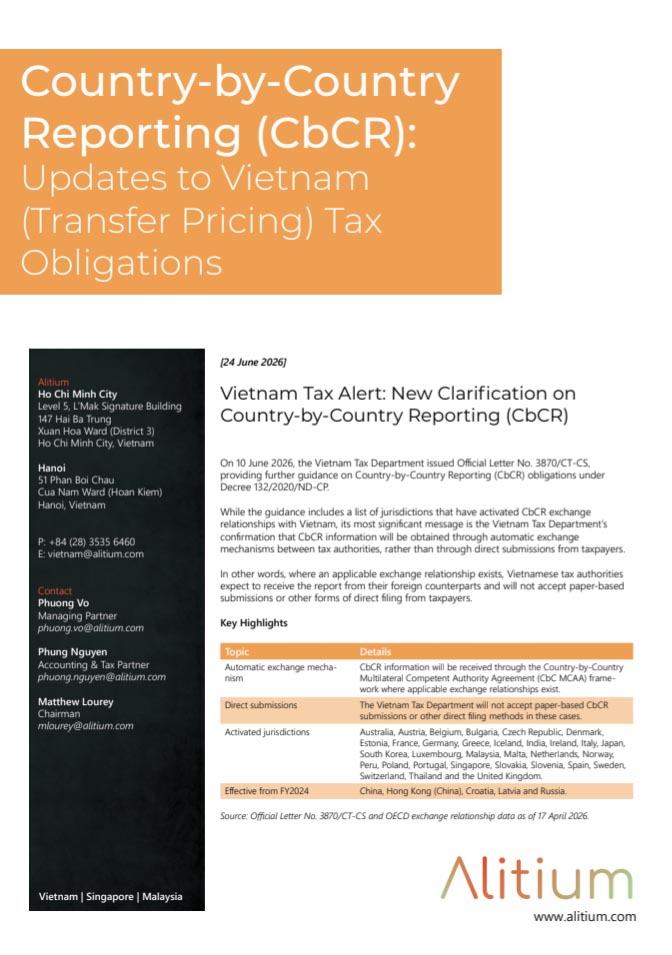
Vietnam Tax Alert: New Clarification on Country-by-Country Reporting (CbCR)
On 10 June 2026, the Vietnam Tax Department issued Official Letter No. 3870/CT-CS, providing further guidance on Country-by-Country Reporting (CbCR) obligations under Decree 132/2020/ND-CP.
While the guidance includes a list of jurisdictions that have activated CbCR exchange relationships with Vietnam, its most significant message is the Vietnam Tax Department’s confirmation that CbCR information will be obtained through automatic exchange mechanisms between tax authorities, rather than through direct submissions from taxpayers.
In other words, where an applicable exchange relationship exists, Vietnamese tax authorities expect to receive the report from their foreign counterparts and will not accept paper-based submissions or other forms of direct filing from taxpayers.
Key highlights
|
Topic |
Details |
|
Automatic exchange mechanism |
CbCR information will be received through the Country-by-Country Multilateral Competent Authority Agreement (CbC MCAA) framework where applicable exchange relationships exist. |
|
Direct submissions |
The Vietnam Tax Department will not accept paper-based CbCR submissions or other direct filing methods in these cases. |
|
Activated jurisdictions |
Australia, Austria, Belgium, Bulgaria, Czech Republic, Denmark, Estonia, France, Germany, Greece, Iceland, India, Ireland, Italy, Japan, South Korea, Luxembourg, Malaysia, Malta, Netherlands, Norway, Peru, Poland, Portugal, Singapore, Slovakia, Slovenia, Spain, Sweden, Switzerland, Thailand and the United Kingdom. |
|
Effective from FY2024 |
China, Hong Kong (China), Croatia, Latvia and Russia. |
Source: Official Letter No. 3870/CT-CS and OECD exchange relationship data as of 17 April 2026.
What Should Businesses Do?
Businesses should review:
- Whether the group’s CbCR filing obligations have been fulfilled in the relevant jurisdiction;
- Whether an effective exchange relationship exists with Vietnam;
- The consistency of information contained in the CbCR, Master File and Local File;
- Potential transfer pricing risks that may become more visible through increased information sharing between tax authorities.
As tax authorities gain broader access to cross-border information, maintaining consistency across transfer pricing documentation and global reporting frameworks will become increasingly important.
Technical Context: What is CbCR and Its Role in Transfer Pricing?
T o understand why this procedural shift matters, it helps to look at the strategic role CbCR plays.
Under Vietnam’s Decree 132 regulating implementation and obligations with transfer pricing in Vietnam (aligned with the OECD’s global BEPS Action 13 framework), transfer pricing compliance relies on a three-tiered documentation structure:
- Local File,
- Master File, and
- Country-by-Country Report (CbCR)
Understanding Definitions and Thresholds for CbCR
A CbC Report is required for large MNE groups with global consolidated revenues of VND 18,000 billion or ~€750 million.
For tax authorities, the purpose of CbCR is not to calculate your exact tax bill, but to perform high-level risk screening. It acts as a map for tax auditors to flag global profit shifting before an audit even begins. Authorities use this automated data to spot discrepancies such as:
- High profits being booked in low-tax jurisdictions where there are zero actual employees or physical assets.
- Massive revenue generated in a country like Vietnam, but minimal profit allocation or corporate income tax paid locally.
If your CbCR shows a significant mismatch between where real economic activity happens and where profits are declared, your local Vietnamese entity is highly likely to be prioritized for a targeted transfer pricing audit.
Looking Ahead
Official Letter 3870 reflects Vietnam’s continued efforts to strengthen international tax cooperation and transparency.
For multinational groups, the key takeaway is that compliance is no longer only about submitting reports. It is equally important to ensure that information reported across different jurisdictions is aligned, consistent and capable of supporting the group’s transfer pricing position if reviewed by tax authorities.
For any further questions or assistance, please reach out to us at vietnam@alitium.com
********
This article is intended to provide an overview of recent updates and announcements. While it aims to present useful insights, it is important to note that the content shared here should not be considered as formal legal, tax or financial advice. For specific guidance on tax obligations or legal matters related to your business, we strongly recommend consulting with a qualified professional, such as a tax advisor or legal expert or directly reach out to us.