Simplifying Cross-Border Documentation: Vietnam’s Adoption of the Apostille Convention and Considerations for Businesses from September 2026
For decades, companies operating across borders have faced a complex and time-consuming process to legalize foreign public documents before they can be used in Vietnam. This soon will change as Vietnam is currently in the process of implementing the Hague Convention 1961, an international framework designed to replace traditional consular legalization with a simplified Apostille certification (the “Convention”). This marks a significant step in administrative reform and international legal integration, with direct implications for cross-border business transactions.
This update outlines: (i) the traditional consular legalization mechanism, (ii) the Apostille mechanism and Vietnam’s timeline for implementation, (iii) the operation and scope of the Apostille mechanism in Vietnam and (iv) its practical implications and key considerations for businesses.
1. The traditional consular legalization mechanism
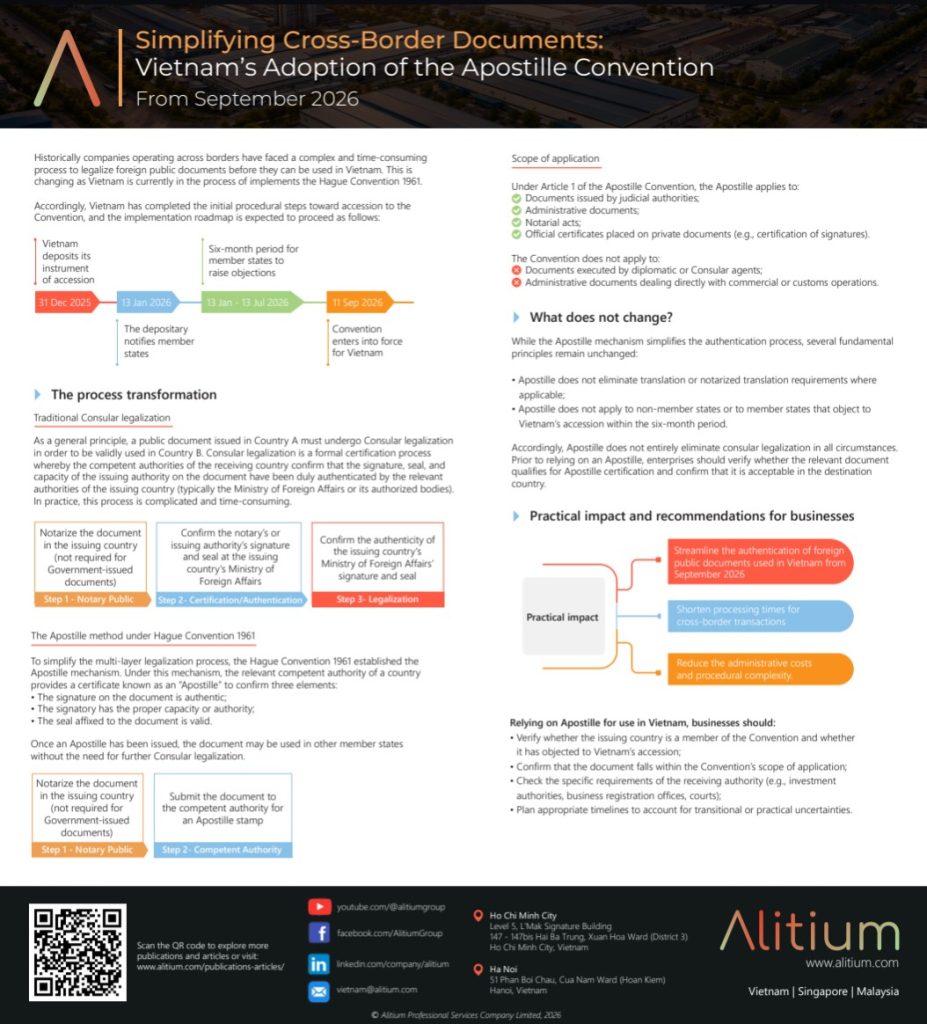
As a general principle, a document issued in Country A must undergo consular legalization in order to be validly used in Country B. Consular legalization is a formal certification process whereby the competent authorities of the receiving country confirm that the signature, seal, and capacity of the issuing authority on the document have been duly authenticated by the relevant authorities of the issuing country (typically the Ministry of Foreign Affairs or its authorized bodies).
In practice, this process is complicated and time-consuming as it usually requires sequential certifications by multiple competent bodies in the issuing country before final legalization by the consular authority of the receiving country. This process often entails additional procedural formalities, extended processing timelines, and corresponding administrative costs.
A typical consular legalization process includes (for reference):
- Notarization of the document (not required for Government-issued documents);
- Certification/Authentication of the document, normally by the issuing country’s Ministry of Foreign Affairs, confirming the authenticity of the notary’s or issuing authority’s signature and seal;
- Legalization by the receiving country’s competent authority, confirming the authenticity of the signature and seal of the issuing country’s Ministry of Foreign Affairs.
2. The Apostille mechanism under Hague Convention 1961
To simplify the multi-layer legalization process, the Hague Convention 1961 established the Apostille mechanism. Under this mechanism, the relevant competent authority of a country provides a certificate known as an “Apostille” to confirm three elements:
- the signature on the document is authentic;
- the signatory has the proper capacity or authority; and
- the seal affixed to the document is valid.
Once an Apostille has been issued, the document may be used in other member states without the need for further consular legalization.
Similar to consular legalization, an Apostille does not certify whether the content of a document is correct, nor does it assess the legality of the underlying transaction. It only confirms the formal authenticity of the signature and seal on the document. The key difference is that, instead of requiring multiple layers of authentication by different authorities, the Apostille allows member states to accept each other’s documents through a single certification. In simple terms, the Apostille replaces a multi-step legalization process with one unified certification based on mutual recognition among member states.
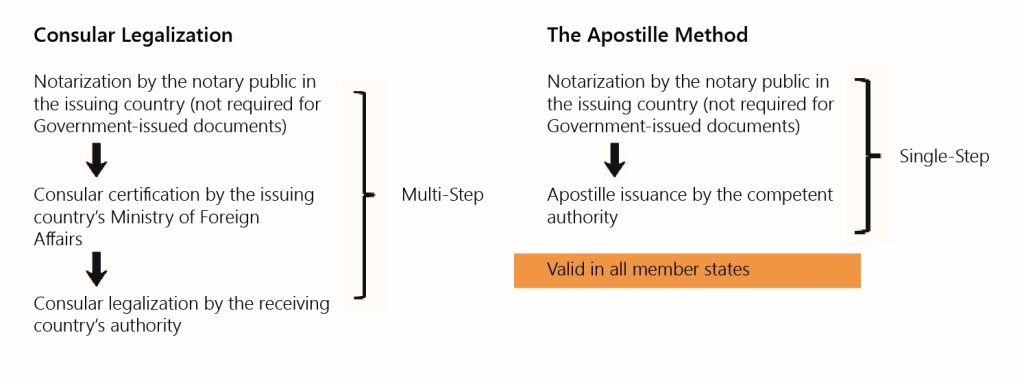
Under Article 1 of the Convention, the Apostille applies to:
- Documents issued by judicial authorities;
- Administrative documents;
- Notarial acts;
- Official certificates placed on private documents (e.g., certification of signatures).
The Convention does not apply to:
- Documents executed by diplomatic or consular agents;
- Administrative documents dealing directly with commercial or customs operations.
3. What does not change?
While the Apostille mechanism simplifies the authentication process, several fundamental principles remain unchanged:
- Apostille does not eliminate translation or notarized translation requirements where applicable;
- Apostille does not apply to non-member states or to member states that object to Vietnam’s accession within the six-month period.
Accordingly, Apostille does not entirely eliminate consular legalization in all circumstances. Prior to relying on an Apostille, enterprises should verify whether the relevant document qualifies for Apostille certification and confirm that it is acceptable in the destination country.
4. How are foreign public documents used in Vietnam?
For foreign public documents intended for use in Vietnam:
- Applicants submit the document (e.g: certificate of incorporation, bizfile, etc) to the competent authority for an Apostille. The designated Apostille authorities in certain jurisdictions, as examples:
- Singapore Academy of Law
- Australia Department of Foreign Affairs and Trade
- High Court of Hong Kong
Please note that an Apostille stamp could be issued in the issuing country or at its Embassy in the receiving country (if available).
- The competent authority verifies the signature and seal and issues the Apostille.
- The document may then be translated into Vietnamese (if required) and used in Vietnam without further consular legalization.
5. Practical impact and recommendations for businesses
The implementation of the Apostille mechanism is expected to streamline the authentication of foreign public documents used in Vietnam from September 2026. In practice, this change may significantly shorten processing times for cross-border transactions, including investment activities or corporate establishment, and other transactions requiring foreign-issued documents. By replacing multi-layer consular legalization procedures with Apostille mechanism, it is also likely to reduce the administrative costs and procedural complexity.
However, before relying on Apostille for use in Vietnam, businesses should:
- Verify whether the issuing country is a member of the Convention and whether it has objected to Vietnam’s accession;
- Confirm that the document falls within the Convention’s scope of application;
- Check the specific requirements of the receiving authority (e.g., investment authorities, business registration offices, courts);
- Plan appropriate timelines to account for transitional or practical uncertainties.
Understanding the scope and limitations of the Apostille mechanism is essential to mitigate the risk of document rejection and ensure smooth cross-border transactions.
What Next
Vietnam’s implementation of the Hague Convention 1961 represents a significant milestone in its international legal integration and administrative reform efforts. While the mechanism does not alter the substantive authentication function of public documents, it fundamentally changes the method of recognition, from a multi-layer diplomatic control model to a streamlined system based on multilateral mutual recognition.
Although Apostille substantially reduces procedural complexity, it does not replace substantive legal review nor eliminate all circumstances requiring consular legalization. Businesses should assess each situation carefully to determine the appropriate authentication route and avoid delays or compliance risks.
For any further questions or assistance, please reach out to us at vietnam@alitium.com
********
This article is intended to provide an overview of recent updates and announcements. While it aims to present useful insights, it is important to note that the content shared here should not be considered as formal legal, tax or financial advice. For specific guidance on tax obligations or legal matters related to your business, we strongly recommend consulting with a qualified professional, such as a tax advisor or legal expert or directly reach out to us.