Update: FDI Enterprises Confirmed Eligible for 3-Year CIT Exemption in Vietnam Under Recent Tax Authority Guidance
When Resolution 198/2025/QH15 and Decree 20/2026/NĐ-CP introduced the new 3-year Corporate Income Tax (“CIT”) exemption for newly established SMEs, one of the most debated questions was whether foreign-invested enterprises (“FDIs”) could qualify for this incentive.
In our earlier article, we analyzed the legislation together with Official Letter 2169/CTPHCM-QLDN3 issued by the Ho Chi Minh City Tax Department. Based on the guidance available at that time, the prevailing interpretation was that enterprises with foreign investment capital were not eligible for the incentive because the policy was intended to support the development of the domestic private economic sector.
Recently, however, the Department of Taxation has issued Official Letter 3896/CT-CS issued on June 11, 2026 confirming that eligible FDI enterprises may also access the 3-year CIT exemption, provided they satisfy all standard statutory conditions to be classified as an SME under the law.
Who May Qualify as an SME?
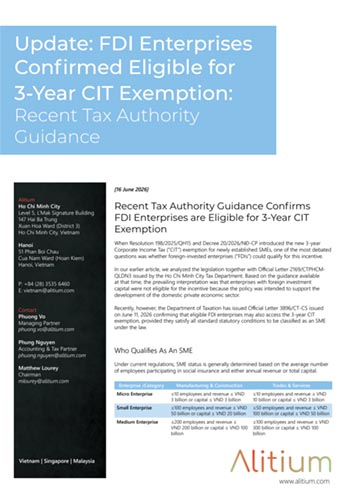
Under current regulations, SME status is generally determined based on the average number of employees participating in social insurance and either annual revenue or total capital.
Enterprise Category | Manufacturing & Construction | Trade & Services |
Micro Enterprise | ≤10 employees and revenue ≤ VND 3 billion or capital ≤ VND 3 billion | ≤10 employees and revenue ≤ VND 10 billion or capital ≤ VND 3 billion |
Small Enterprise | ≤100 employees and revenue ≤ VND 50 billion or capital ≤ VND 20 billion | ≤50 employees and revenue ≤ VND 100 billion or capital ≤ VND 50 billion |
Medium Enterprise | ≤200 employees and revenue ≤ VND 200 billion or capital ≤ VND 100 billion | ≤100 employees and revenue ≤ VND 300 billion or capital ≤ VND 100 billion |
Note: Meeting the SME thresholds alone does not automatically qualify an enterprise for the 3-year CIT exemption. Enterprises must also be newly established and satisfy the conditions under Resolution No. 198/2025/QH15 and Decree No. 20/2026/ND-CP.
The exemption period is generally available for the first three years from the initial issuance of the Enterprise Registration Certificate. Transitional provisions may apply to enterprises established before Resolution No. 198/2025/QH15 took effect.
Based on the above thresholds, many newly established foreign-invested enterprises may potentially qualify as SMEs and should assess their eligibility for the incentive.
Key Exclusions
The 3-year CIT exemption is not available to certain newly established enterprises, including:
- Enterprises established because of mergers, consolidations, divisions, separations, ownership transfers, or changes in business form.
- Enterprises where the legal representative (except where such person is not a capital contributor), general partner, or largest capital contributor previously held the same position in another enterprise that is currently operating or was dissolved less than 12 months before the establishment of the new enterprise.
- Income categories specified in Clause 3, Article 18 of the Corporate Income Tax Law No. 67/2025/QH15.
Strategic Implications of Official Letter 3896/CT-CS
The issuance of this new guidance carries significant implications for corporate planning, financial modeling, and tax compliance structures.
Regulatory Dynamic | Impact on Foreign Investors |
Operational Certainty | Eliminates conflicting local interpretations and regional tax friction, establishing a uniform national standard. |
Statutory Priority | Affirms that where legislation does not explicitly exclude a specific class of taxpayers, eligibility must be assessed strictly against legal criteria rather than assumed policy intent. |
Financial Runway | Optimizes cash flow for foreign-invested startups and SMEs during their first three years of operation—the most capital-intensive phase of market entry. |
Recommended Action Items for Management
- Review whether your company meets the SME criteria under the applicable regulations.
- Assess whether the conditions for the 3-year CIT exemption have been satisfied.
- If the exemption was not considered in your FY2025 CIT planning or tax filings, consider reviewing whether any adjustments or additional filings may be available based on the latest guidance
A formal review of corporate structures against the statutory criteria of Decree 20/2026/NĐ-CP and Official Letter 3896/CT-CS is highly recommended to determine if your organization can legally leverage this exemption to optimize its tax footprint in Vietnam.
For any further questions or assistance with your taxation support, please reach out to us at vietnam@alitium.com
********
This article is intended to provide an overview of recent updates and announcements. While it aims to present useful insights, it is important to note that the content shared here should not be considered as formal legal, tax or financial advice. For specific guidance on tax obligations or legal matters related to your business, we strongly recommend consulting with a qualified professional, such as a tax advisor or legal expert or directly reach out to us.