Simplifying Cross-Border Documents: Vietnam’s Implementation of the Apostille Convention and Considerations for
Businesses
For decades, businesses operating across borders have faced a complex and time-consuming process to authenticate foreign public documents before they can be used in Vietnam. This is set to change following Vietnam’s accession to the Hague Convention of 5 October 1961 Abolishing the Requirement of Legalisation for Foreign Public Documents (the “Apostille Convention”), which introduces a simplified Apostille mechanism in place of the traditional multi-layer consular legalisation process for qualifying public documents.
The Apostille Convention will enter into force for Vietnam on 11 September 2026. To establish the domestic framework for its implementation, the Government issued Decree No. 293/2026/ND-CP on 23 July 2026 (“Decree 293”), which will take effect on the same date. Together, the Apostille Convention and Decree 293 mark a significant change in the authentication and use of foreign public documents in Vietnam, with practical implications for cross-border investment and corporate licensing and other business transactions.
This update outlines: (i) the traditional consular legalisation mechanism; (ii) the Apostille mechanism and how it operates in Vietnam; (iii) the transitional treatment of documents and applications already in process before 11 September 2026; and (iv) the key practical implications and considerations for businesses.
1. The traditional consular legalisation mechanism
Prior to the Apostille Convention taking effect for Vietnam, foreign documents intended for use in Vietnam generally had to undergo consular legalisation, unless an applicable exemption applied. This typically involved a chain of authentication, under which the relevant authorities successively verified the signatures, seals and official capacities appearing on the document or on the preceding certification before final legalisation by the competent Vietnamese authority.
While the precise steps may vary depending on the nature of the document and the issuing jurisdiction, a typical consular legalisation process may involve:
(i) Notarisation of the document, where required (e.g. privately executed documents, copies of documents issued by a competent public authority);
(ii) Certification or authentication by the competent authority of the issuing State, commonly its Ministry of Foreign Affairs or another designated authority, confirming the authenticity of the notary’s or issuing authority’s signature, seal and official capacity;
(iii) Consular legalisation by the receiving country’s competent authority, which authenticates the certification made by the issuing country’s Ministry of Foreign Affairs for the purpose of the document being recognised and used in Vietnam.
Consular legalisation does not verify the substantive accuracy or legality of the underlying document or transaction. Its function is limited to authenticating the relevant signatures, seals and official capacities through the prescribed certification chain.
Because this process may involve several authorities across different jurisdictions, it can result in additional procedural steps, longer processing times and increased administrative costs. The Apostille Convention is intended to simplify this process by replacing this multi-layer authentication mechanism with a single Apostille certification in qualifying cases.
2. The Apostille mechanism and how it works in Vietnam
The Apostille Convention simplifies the traditional authentication process by replacing the additional consular legalisation layer with a single Apostille certificate issued by the designated competent authority of the issuing State.
Once a foreign public document has been duly Apostilled by the competent authority of a Contracting State with which the Apostille Convention is in force in relation to Vietnam, and is not subject to refusal, the document is exempt from further consular certification or legalisation in Vietnam. Authorities and organisations in Vietnam shall not require any further consular certification or legalisation of a foreign public document that has been duly issued with a valid Apostille.
As a simplified alternative to consular legalisation, an Apostille similarly does not certify the substantive accuracy of the document or the legality of the underlying transaction. Rather, its function is limited to certifying the origin of the public document, including the authenticity of the signature, the capacity in which the signatory acted, and the identity of any seal or stamp appearing on the document.
Decree 293 also establishes the legal framework for electronic Apostilles (e-Apostilles) and electronic verification. An e-Apostille has the same legal effect as a paper Apostille and may be verified through the relevant electronic register, including by online lookup or QR-code scanning where available. The relevant electronic systems in Vietnam will, however, be introduced in accordance with the implementation roadmap for Vietnam’s Apostille Information System.
Important: an Apostille does not remove the domestic formalities applicable to the use of foreign documents in Vietnam. Under Decree 293, a foreign public document bearing an Apostille that is not in Vietnamese must still be translated into Vietnamese, and the translation must be notarised or certified in accordance with Vietnamese law, unless otherwise provided under specialised legislation. The Apostille therefore replaces the consular legalisation requirement, rather than all documentary formalities applicable in Vietnam.
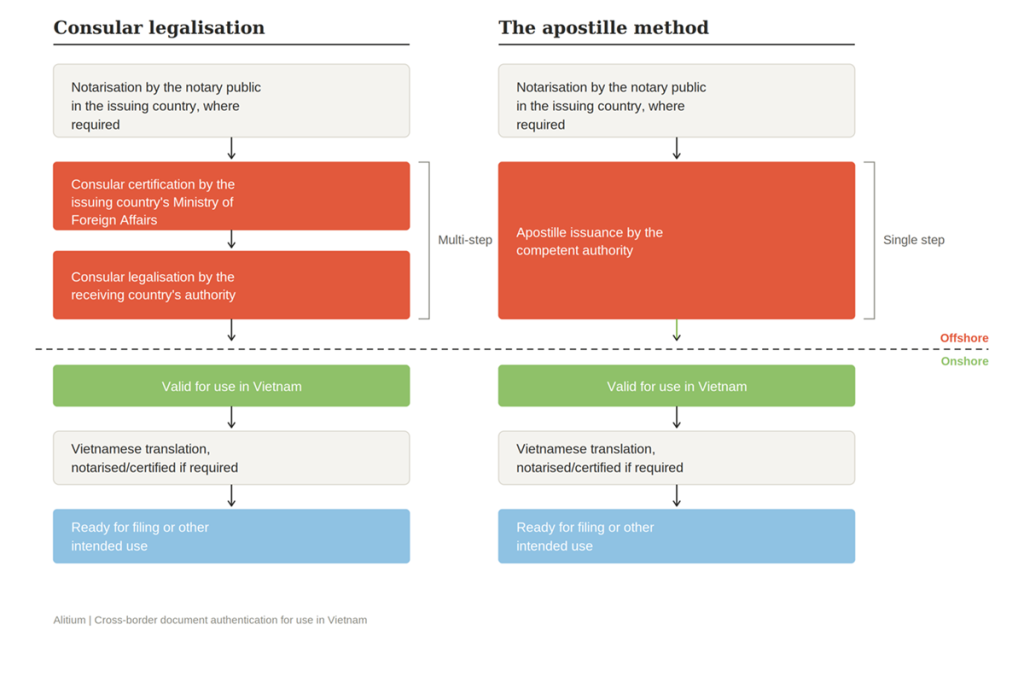
* Consular legalisation or Apostille is normally completed offshore; however, either may be completed onshore in Vietnam where such services are available through the issuing country’s diplomatic or consular mission in Vietnam.
Documents within the scope of the Apostille Convention
- Documents issued by judicial or court authorities;
- Administrative documents, such as certificates of incorporation, business registration documents, criminal records and academic qualifications.
- Notarial acts;
- Official certificates placed on private documents (e.g., certification of signatures).
When may an Apostilled document still be refused in Vietnam?
An Apostille does not guarantee acceptance of the underlying document in all circumstances. In Vietnam, an Apostilled document may be refused in the following cases:
- Diplomatic or consular documents and documents relating directly to commercial or customs operations.
- The Apostille was not issued by the competent authority of the issuing state or fail to contain the prescribed French-language heading or the mandatory particulars required by the Apostille Convention.
- The document or Apostille shows signs of unauthorized alteration, erasure or forgery.
- The content of the document violates Vietnamese law, infringes the interests of the Vietnamese State, or conflicts with fundamental principles of public order or social morality in Vietnam.
- The Apostille has been annulled or revoked by the competent authority of the issuing state.
When does the Apostille Convention apply between Vietnam and another State?
The Apostille Convention does not apply to documents from every country. For the Apostille route to be available, the issuing State must be a Contracting State and the Apostille Convention must be in force in its relationship with Vietnam.
Membership in the Apostille Convention alone is therefore not sufficient. The Apostille Convention will not apply between Vietnam and a Contracting State where that State has objected to Vietnam’s accession, or where the Apostille Convention has otherwise not yet entered into force in the relevant relationship. In such cases, the traditional consular legalisation process may continue to apply, unless another applicable treaty or exemption provides otherwise.
Under Decree 293, the Ministry of Foreign Affairs is required to update and publish the list of contracting states having an applicable Apostille Convention relationship with Vietnam on its official website and the National Public Service Portal. Pending publication of this list, businesses may refer to the HCCH Apostille Convention Status Table to check the current status of contracting states, including relevant dates of entry into force and objections.
Businesses should therefore verify the status of the relevant jurisdiction before relying on an Apostille for documents intended for use in Vietnam.
3. Transitional arrangements for existing documents and pending applications
Transitional rules apply to documents certified or authenticated before 11 September 2026, as follows:
- Consular certification applications validly received before 11 September 2026 but not yet resolved will continue under the existing rules. Applicants may also request an Apostille for the same document.
- Foreign public documents already legalised in Vietnam before 11 September 2026 remain valid and do not require a new Apostille.
- Apostilles issued by a competent authority of a Contracting State with an applicable relationship with Vietnam before the Apostille Convention takes effect for Vietnam will be accepted in Vietnam.
4. Practical impact and recommendations for businesses
The implementation of the Apostille mechanism is expected to streamline the authentication of foreign public documents used in Vietnam from 11 September 2026, which may reduce processing time and administrative costs by removing the need for further consular legalisation in Vietnam, while providing a simplified and standardised authentication mechanism for cross-border use of public documents. This mechanism is expected to facilitate foreign investors in preparing documents for administrative procedures in Vietnam, such as investment procedures and work permit applications. Typical examples include certificates of incorporation, business registration records, notarised or certified copies of passports of individual investors or legal representatives, criminal records, diplomas and professional qualification certificates, as well as other public documents required for the relevant procedures.
However, before relying on Apostille for use in Vietnam, businesses should:
- Verify whether the issuing country is a member of the Apostille Convention and whether it has objected to Vietnam’s accession;
- Confirm that the document falls within the Apostille Convention’s scope of application;
- Check the specific requirements of the receiving authority (e.g., investment authorities, business registration offices, courts);
- Plan appropriate timelines to account for transitional or practical uncertainties.
Understanding the scope and limitations of the Apostille mechanism is essential to mitigate the risk of document rejection and ensure smooth cross-border transactions.
Conclusion
Vietnam’s implementation of the Apostille Convention, together with Decree 293, marks a significant shift in the way foreign public documents will be authenticated and used in Vietnam from 11 September 2026. For qualifying documents originating from contracting states with which the Apostille Convention is in force in relation to Vietnam, the Apostille mechanism will replace the traditional multi-layer consular legalisation process with a more streamlined form of authentication.
The new regime, however, is not universal. Its availability depends on both the status of the issuing State and the nature of the document concerned, while Vietnamese requirements relating to translation, notarisation, certification and filing may continue to apply. An Apostille also does not guarantee acceptance of the underlying document where any of the refusal grounds under Decree 293 are triggered.
For businesses, the practical benefit is clear. The authentication process should become shorter, more predictable and less administratively burdensome. At the same time, careful assessment will still be required on a jurisdiction-by-jurisdiction and document-by-document basis, particularly during the transition to the new regime. Businesses should therefore confirm the applicable country status, document eligibility and Vietnamese filing requirements at an early stage to minimise the risk of rejection or delay in cross-border transactions.
For any further questions you may have, please reach out to us at vietnam@alitium.com
********
This article is intended to provide an overview of recent updates and announcements. While it aims to present useful insights, it is important to note that the content shared here should not be considered as formal legal, tax or financial advice. For specific guidance on tax obligations or legal matters related to your business, we strongly recommend consulting with a qualified professional, such as a tax advisor or legal expert or directly reach out to us.