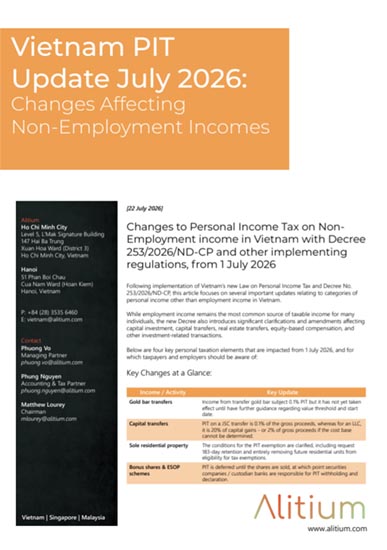
Changes to Personal Income Tax on Non-Employment income in Vietnam with Decree 253/2026/ND-CP and other implementing regulations, from 1 July 2026
Following implementation of Vietnam’s new Law on Personal Income Tax and Decree No. 253/2026/ND-CP, this article focuses on several important updates relating to categories of personal income other than employment income in Vietnam.
While employment income remains the most common source of taxable income for many individuals, the new Decree also introduces significant clarifications and amendments affecting capital investment, capital transfers, real estate transfers, equity-based compensation, and other investment-related transactions.
Key Changes at a Glance
Below are four key personal taxation elements that are impacted from 1 July 2026, and for which taxpayers and employers should be aware of:
Income / Activity | Key Update |
Gold bar transfers | Income from transfer gold bar subject 0.1% PIT but it has not yet taken effect until have further guidance regarding value threshold and start date. |
Capital transfers | PIT on a JSC share transfer remains at 0.1% of gross proceeds. For an LLC, the new regulation creates greater tax fairness by applying the same rates to both residents and non-residents: 20% on net profit, or 2% on total proceeds if the cost base cannot be determined. |
Sole residential property | The conditions for the PIT exemption are clarified, including request 183-day retention and entirely removing future residential units from eligibility for tax exemptions. |
Bonus shares & ESOP | PIT is deferred until the shares are sold, at which point securities companies / custodian banks are responsible for PIT withholding and declaration. |
1. Vietnam’s Gold Bar Trading Tax Regulations
Based on the Law on Personal Income Tax No. 109/2025/QH15 and Decree No. 253/2026/ND-CP, earnings from transferring gold bars are classified as taxable “Other Income” (alongside digital assets, “.vn” domains, and carbon credits).
A flat 0.1% PIT is applied to the transfer price per transaction for both resident and non-resident individuals in Vietnam. Income from gold deposit interest at credit institutions remains tax-exempt.
The Government will issue separate guidelines to specify the taxable value threshold (the minimum transaction amount subject to tax), the implementation roadmap, and any necessary tax rate adjustments.
2. Updated Tax Treatment for Capital Gains
Decree No. 253/2026/ND-CP revises the PIT treatment for non-resident individuals transferring of LLC.
Previously, non-residents transferring LLC capital paid a flat 0.1% on gross proceeds, whereas tax resident were taxed at 20% of the capital gain.
Under the new Decree, a unified approach applies to:
- JSC shares (listed or non-listed): 0.1% of the gross transfer proceeds, regardless of residency status
- LLC capital contribution: PIT is 20% of the capital gain, or 2% of the gross transfer proceeds where the acquisition cost cannot be determined, regardless residency status.
Taxpayers are exempt from PIT in the following cases:
- Innovative Startups: PITis exempt for income from transferring innovative startup projects or capital contributions into venture capital funds,
- Open-ended Funds: Transfers of certificates of open-ended investment funds are tax-exempt if held for at least 2 years from the date of purchase, and
- Private Business/One-member LLC Owners: Income is exempt after the business has fulfilled its Corporate Income Tax (CIT) obligations when the owner withdraws or transfers capital (unless it involves real estate)
This amendment aligns the tax treatment of different forms of capital transfers while encouraging taxpayers to maintain sufficient documentation to substantiate their acquisition cost and related expenses.
3. Clarification of PIT Exemption for Transfers of Sole Residential Property
One of the most important updates relates to the PIT exemption applicable to individuals transferring their only residential property.
The Decree further clarifies the eligibility conditions and narrows the scope of the exemption by:
- Expressly excluding transfers of future residential houses and construction works formed in the future from the exemption; and
- Providing more detailed criteria for determining whether an individual owns only one residential house or one residential land use right.
To qualify for the exemption, an individual must own only one residential house or one residential land use right (including any house or construction attached to the land) at the time of the transfer. Importantly, where the individual also owns a future residential house or construction work at the time of the transfer, the exemption will not apply.
In cases of co-owned residential property or jointly held residential land use rights (including property jointly owned by spouses), the exemption is available only to the co-owner who does not own any other residential house or residential land use right in Vietnam. Any co-owner who owns another residential property elsewhere will not be eligible for the exemption.
These clarifications are expected to reduce inconsistent interpretations during tax administration and provide greater certainty for taxpayers when determining their eligibility for the exemption.
Individuals planning to transfer residential property should carefully assess whether all statutory conditions are satisfied before relying on the tax exemption.
4. New Tax Withholding Mechanism for Bonus Shares and ESOP Shares
The Decree also introduces key changes regarding tax mechanisms, payment timing, and withholding responsibilities as follows:
Income Classification and the Tax “Deferral” Mechanism
- Classification: Bonus shares and ESOP shares are classified as employment income (salaries and wages).
- Taxable Event / Timing: A key update is that employees are not required to calculate or pay tax at the time they receive the shares. The tax obligation arises only when the individual transfers (sells) these shares.
Determination of Taxable Income (New Formula Rules)
Upon transfer, the employment income portion is determined as follows:
- For Bonus Shares: Calculated based on the amount recorded in the income-paying entity’s accounting books. If that amount cannot be determined, it is calculated as:
- For ESOP Shares: Calculated as:
Number of Shares Received x (Par Value – Actual Price Paid by Emloyee)
- Relief for Dropping Market Prices: If the market transfer price at the time of sale is lower than the par value, the taxable employment income will instead be calculated based on the market price at the time of transfer.
Dual Tax Obligation Upon Transfer
At the time of transfer, the taxpayer is subject to two concurrent tax liabilities:
- Employment Income Tax: Calculated on the gain/value of the granted shares, and
- Securities Transfer Tax: Subject to a flat rate of 0.1% on the actual gross transfer value of each transaction.
Withholding & Finalization
- Depository Withholding: Securities firms or custodian banks must track these shares and automatically withhold 10% on the employment income portion upon sale.
- Annual Finalization: Individuals must declare these shares and aggregate the benefit into their annual employment income for tax finalization under progressive rates.
These detailed regulations aim to standardize the tax administration process for equity-based compensation and officially take effect on 1 July 2026.
Final Thoughts
Beyond employment income, Decree No. 253/2026/ND-CP refines Personal Income Tax rules for investment income, capital transfers, real estate, equity compensation, and sets the stage for future rules on gold bar transfers.
While some updates merely clarify existing rules, others introduce new compliance obligations for individuals, employers, securities firms, custodian banks, and investors. Taxpayers should review these changes to ensure full compliance ahead of future transactions.
For any further questions or assistance, please reach out to us at vietnam@alitium.com
********
This article is intended to provide an overview of recent updates and announcements. While it aims to present useful insights, it is important to note that the content shared here should not be considered as formal legal, tax or financial advice. For specific guidance on tax obligations or legal matters related to your business, we strongly recommend consulting with a qualified professional, such as a tax advisor or legal expert or directly reach out to us.