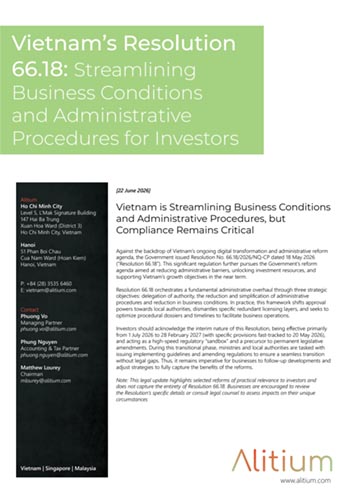
Vietnam is Streamlining Business Conditions and Administrative Procedures
Against the backdrop of Vietnam’s ongoing digital transformation and administrative reform agenda, the Government issued Resolution No. 66.18/2026/NQ-CP dated 18 May 2026 (“Resolution 66.18”). This significant regulation further pursues the Government’s reform agenda aimed at reducing administrative barriers, unlocking investment resources, and supporting Vietnam’s growth objectives in the near term.
Resolution 66.18 orchestrates a fundamental administrative overhaul through three strategic objectives: delegation of authority, the reduction and simplification of administrative procedures and reduction in business conditions. In practice, this framework shifts approval powers towards local authorities, dismantles specific redundant licensing layers, and seeks to optimize procedural dossiers and timelines to facilitate business operations.
Investors should acknowledge the interim nature of this Resolution, being effective primarily from 1 July 2026 to 28 February 2027 (with specific provisions fast-tracked to 20 May 2026), and acting as a high-speed regulatory “sandbox” and a precursor to permanent legislative amendments. During this transitional phase, ministries and local authorities are tasked with issuing implementing guidelines and amending regulations to ensure a seamless transition without legal gaps. Thus, it remains imperative for businesses to follow-up developments and adjust strategies to fully capture the benefits of the reforms.
Note: This legal update highlights selected reforms of practical relevance to investors and does not capture the entirety of Resolution 66.18. Businesses are encouraged to review the Resolution’s specific details or consult legal counsel to assess impacts on their unique circumstances
Executive Highlights
1. Merger Control: Financial thresholds for mandatory notification are doubled, facilitating mid-sized M&A transactions.
2. Fire Safety Acceptance Inspections: Acceptance inspection procedures are abolished for construction works with prior design appraisal approval.
3. Labour Subleasing & Employment Services: Licensing requirements for labour subleasing and employment services are removed, shifting to a notification and deposit-based model.
4. Data Synthesis and Analysis Services: Market entry for data synthesis and analysis services is liberalized through the removal of the Certificate of Eligibility.
5. Alcohol and Tobacco Business: Broad removal of licensing for alcohol and tobacco across production, distribution, and retail sectors.
6. Foreign-Linked Education Activities: Greater autonomy for foreign-linked training activities (excluding foreign-invested education institutions) through the removal of prior approvals.
7. Upstream Oil and Gas: Extensions of petroleum contracts and transfers of rights and obligations are no longer subject to State approval; instead, they are determined internally by PetroVietnam, granting greater autonomy to the industry
1. Calibrating Merger Control
One of the most significant changes for the M&A landscape is the doubling of financial thresholds for mandatory merger control notifications, which are currently set out under Decree No. 35/2020. Specifically:
Merger Control Threshold | Pre-July 2026 Threshold | Post-July 2026 Threshold under Resolution 66.18 |
Total asset value in Vietnam | VND 3,000 billion | VND 6,000 billion |
Total turnover in Vietnam | VND 3,000 billion | VND 6,000 billion |
Transaction value | VND 1,000 billion | VND 2,000 billion |
Combined market share | 20% | 20% (unchanged) |
The liberalization of Vietnam’s competition framework reflects a more calibrated approach to market oversight. By doubling the notification thresholds for economic concentration, the government has signalled a move to focus enforcement resources on transactions with genuine potential to distort competition, while granting “green-channel” freedom to mid-sized corporate restructurings.
For investors, this shift significantly accelerates transaction timelines by removing mandatory pre-closing filings for a vast swathe of mid-market deals. It reduces administrative costs and facilitates smoother corporate restructuring. However, it is vital to note that while the procedural burden is reduced, substantive competition compliance remains paramount. Transactions exceeding the 20% market share threshold or those with potential anti-competitive effects remain subject to regulatory scrutiny.
2. Fire Safety Acceptance Inspections
A pivotal reform introduced by Resolution 66.18 is the abolition of acceptance inspections for fire prevention, fighting, and rescue (PCCC). Historically, under the Law on Fire Prevention, Fighting and Rescue 2024, construction works and vehicles subject to design appraisal were required to undergo a mandatory commissioning inspection by police authorities prior to operation. Resolution 66.18 significantly relaxes this requirement by discontinuing such inspections for projects that have already secured fire safety design appraisal certificates, effectively shifting the regulatory focus toward a framework of self-responsibility and post-inspection.
This strategic adjustment is expected to unblock a major procedural bottleneck for thousands of projects that faced significant delays while awaiting post-construction technical approvals, even after investors had diligently fulfilled their construction responsibilities. However, it is vital to note that this reform only simplifies the transition to the operational phase and does not dilute core safety obligations. Project owners and businesses remain strictly liable for maintaining foundational fire safety mandates, including securing prior design appraisals, preparing necessary legal dossiers, and ensuring continuous adherence to technical and safety standards throughout the facility’s lifecycle. This calibrated approach allows the State to grant immediate operational flexibility while retaining the essential authority to manage high-risk works and intervene promptly should violations be identified during the operational phase.
3. Labour Subleasing & Employment Services
Resolution 66.18 introduces a significant administrative reform by abolishing pre-operational licensing requirements for labour subleasing and employment services. In particular:
- Labour subleasing: The licensing regime will be replaced by a framework based on statutory deposit, notification and post-inspection. Key requirements include:
- Statutory deposit: Businesses must maintain the mandatory deposit of VND 2 billion. Notably, the new mechanism exempts businesses from the requirement to replenish the deposit following authorized withdrawals for specific purposes approved by the competent authorities.
- Notification and reporting: Businesses must notify their operation to the Department of Home Affairs, submit quarterly reports, and promptly update any organizational changes or cessation of operation.
- Employee protection: Businesses remain responsible for ensuring the rights and legitimate interests of subleased employees throughout the subleasing arrangement.
- Employment services: The reform is even more expansive, involving the total removal of both licensing and deposit requirements. Businesses now only need to notify their operation to the Department of Home Affairs through the National Employment Exchange Platform, publicly disclose operational information, post working hours and service fees, update recruitment results, manage and protect labour data, and submit semi-annual and annual reports. Notably, employment service providers maintaining a deposit at a deposit-receiving bank may withdraw such deposit without obtaining prior written approval from the competent authority.
Overall, these changes are expected to reduce market entry barriers and initial compliance costs for businesses in the staffing and employment services sector. The reforms may be particularly relevant to the IT and technology sector, where staff augmentation, personnel outsourcing and cross-border deployment of technical personnel are commonly used to access specialized talent and scale operations.
4. Data Analysis and Synthesis Services
Data has transitioned from a functional operational input into a strategic asset with profound implications for privacy, cybersecurity, and national interests. Recognizing these sensitivities, data-related services were historically classified as “conditional business lines” under Decree No. 169/2025, requiring enterprises to obtain a “Certificate of Eligibility” by satisfying a complex matrix of criteria regarding personnel, technological infrastructure, and business modelling.
Against the backdrop of Vietnam’s policy agenda to accelerate the digital economy, as codified in Decision No. 1033/QD-TTg – the Government has adopted a more facilitative regulatory stance in Resolution 66.18. Resolution 66.18 adopts a more facilitative regulatory stance. In particular, data analysis and synthesis services, which play an enabling role in data-driven business models such as e-commerce, AI, business intelligence and big data solutions, will no longer be subject to the requirement to obtain a Certificate of Eligibility.
This reform provides a dual-layer of support. It directly reduces market entry barriers for service providers, while indirectly empowers the broader digital ecosystem that relies on these services to drive their own business activities.
Nevertheless, investors must recognize that the removal of this specific certificate does not equate to total deregulation. Businesses remain strictly obligated to navigate a fragmented regulatory landscape concerning data privacy, cybersecurity, and intellectual property rights. Ensuring the legal sourcing of data and maintaining robust security standards across all operations remains a core compliance mandate under prevailing laws.
5. Alcohol and Tobacco Business
Traditionally subject to stringent controls, the alcohol and tobacco sectors are experiencing a major “cleansing” of administrative layers under Resolution 66.18. This reform targets the dismantling of licensing requirements across the entire value chain. In particular:
- Tobacco: Resolution 66.18 discontinues the mandatory licensing for trading, retail, and cultivation investment previously required under the Law on Prevention and Control of Tobacco Harms 2012. Oversight now transitions to a compliance model rooted in adhering to remaining legal requirements and rigorous post-inspection during operation.
- Alcohol: Under Resolution 66.17/2026/NQ-CP, alcohol business has been removed from the list of conditional business lines. Building on this reform, Resolution 66.18 further abolishes the requirement to obtain licences for alcohol distribution, wholesale, retail, commercial production of handmade alcohol and industrial alcohol production, which is previously required under Decree No. 17/2020/ND-CP. The Resolution also removes various business conditions applicable to alcohol distribution, wholesale, retail, on-premise alcohol sale, importation and trading of alcohol below 5.5% ABV. As a consequence, certain administrative penalties relating to unlicensed alcohol business activities have also been abolished to align with the new framework.
Overall, Resolution 66.18 reflects a policy shift toward reducing market entry barriers in the alcohol and tobacco sectors, while maintaining State oversight through the remaining sector-specific requirements, self-compliance obligations and post-inspection mechanisms. The reforms are expected to lower regulatory burdens and compliance costs, although businesses should continue to treat these sectors as closely regulated from an operational compliance perspective.
6. Education and Training
Resolution 66.18 builds upon the internationalization of Vietnam’s education sector by dismantling prior approval requirements for foreign-linked education and training activities (except foreign-invested educational institutions).
In particular, Resolution 66.18 abolishes a number of prior approval and conditions that were previously required under Decree No. 95/2026/ND-CP, including:
- Approval for foreign-linked education activities at preschool and general education levels;
- Approval for foreign-linked training at bachelor’s, master’s, and doctoral levels;
- Approval for the foreign-linked organization of examinations for foreign language proficiency certificates; and
- Certificates of registration for foreign-linked training activities applicable to colleges, intermediate schools and vocational secondary schools.
This reform shifts the compliance burden to the relevant institution, which remains responsible for maintaining the statutory conditions applicable to the program, safeguarding the rights and interests of learners, and fulfilling applicable reporting obligations to the competent authorities throughout implementation.
7. Upstram Oil and Gas
Resolution 66.18 streamlines the approval process for certain upstream petroleum activities by suspending several State-level approval requirements. In particular, prior approval from competent State authorities will no longer be required for contractor selection plans, contractor appointment results, petroleum contract term extensions, and transfers of rights and obligations under petroleum contracts.
These matters will instead be reviewed and approved by PetroVietnam in accordance with its internal governance and decision-making procedures.
Strategic Recommendations
The reforms under Resolution 66.18 represent a meaningful shift in the regulatory approach of Vietnamese authorities, moving from pre-check procedures toward self-compliance and post-inspection. However, the reduction of upfront procedures places greater importance on internal governance and ongoing compliance.
Investors should consider the following:
- Review licensing requirements: Identify licences, approvals or business conditions that are no longer required and assess whether project timelines or market entry plans can be accelerated.
- Strengthen internal compliance controls: As the regulatory focus shifts to post-inspection, businesses should maintain proper records, audit trails, technical compliance documents and internal procedures to demonstrate compliance during operational checks.
- Monitor transitional developments: Given the interim nature of Resolution 66.18, businesses should closely monitor follow-up legal instruments and promptly adjust their compliance strategies to remain aligned with the evolving regulatory framework. Investors should also assess whether to move ahead under the current transitional framework or wait for a more permanent legal framework, depending on the nature and timing of their proposed investment.
Given the breadth of the reforms and their sector-specific implications, investors should take this opportunity to reassess their licensing position, operating model and market entry strategy. However, as Resolution 66.18 is transitional in nature and further guidance may follow, investors are encouraged to carefully review the applicable requirements and seek guidance from the competent authorities or legal counsel before implementing any changes during this period.
For any further questions or assistance with your investment support, please reach out to us at vietnam@alitium.com
********
This article is intended to provide an overview of recent updates and announcements. While it aims to present useful insights, it is important to note that the content shared here should not be considered as formal legal, tax or financial advice. For specific guidance on tax obligations or legal matters related to your business, we strongly recommend consulting with a qualified professional, such as a tax advisor or legal expert or directly reach out to us.