Vietnam’s Resolution 66.18: Streamlining Business Conditions and Administrative Procedures for Investors

Vietnam’s Resolution 66.18 introduces significant reforms aimed at reducing business conditions, simplifying administrative procedures and accelerating investment activity. Key changes include higher merger control thresholds, reduced licensing requirements across multiple sectors, streamlined fire safety approvals, reforms to labour subleasing and employment services, and greater flexibility for education, data and petroleum activities.
Malaysia Compliance Calendar 2026–2027: Key Corporate, Tax and Payroll Deadlines

The Alitium Malaysia Compliance Calendar 2026–2027 provides a practical overview of key compliance obligations for Malaysian private companies (Sdn Bhd). Covering corporate secretarial requirements, annual returns, financial statement lodgements, corporate income tax, SST, withholding tax, payroll reporting, EPF, SOCSO, EIS and HRD Corp obligations, this complimentary resource helps businesses plan ahead, meet statutory deadlines and reduce compliance risks.
FDI Enterprises Eligible for 3-Year Tax Exemption in Vietnam

Vietnam’s Department of Taxation has clarified that eligible foreign-invested enterprises (FDIs) may access the new 3-year Corporate Income Tax exemption available to qualifying SMEs. This update resolves a key area of uncertainty following Resolution 198/2025/QH15 and Decree 20/2026/NĐ-CP. The article outlines the SME qualification criteria, key exclusions, strategic implications for foreign investors, and practical steps businesses should take to assess eligibility.
PIT Dependant Registration in Vietnam: Five Common Compliance Risks for Employers and Employees

Vietnam’s PIT dependant deduction can deliver significant tax savings, but incorrect registrations may expose both employees and employers to reassessments, interest and compliance risks. This article examines five common pitfalls, including duplicate claims, non-immediate family dependants, employment-related registration gaps and overreliance on registration approvals. It also outlines practical steps HR and payroll teams can take to strengthen compliance and reduce tax exposure.
Representative Offices in Vietnam: Tax Risks, Compliance Obligations and Permanent Establishment Exposure

Representative Offices (ROs) remain a popular entry structure for foreign investors entering Vietnam, but they are often misunderstood from a compliance perspective. This guide examines the legal framework governing ROs, their permitted activities, payroll and labour obligations, Personal Income Tax exposure for Chief Representatives, and the often-overlooked risk of creating a Permanent Establishment for the foreign parent. Understanding these issues is critical to avoiding tax disputes, penalties, and operational disruption.
Vietnam’s Decree 96 on Investment 2026: Key Changes for Foreign Investors and Investment Projects

Vietnam’s Decree 96/2026/ND-CP provides the implementing framework for the new Law on Investment 2025 and introduces significant changes for investors. This guide examines the new ERC-first establishment model, streamlined investment procedures, digitalisation of filings, project security deposit requirements, investment incentives for technology and strategic sectors, and revised rules for project extensions. Foreign investors should understand both the opportunities and compliance obligations arising from these reforms.
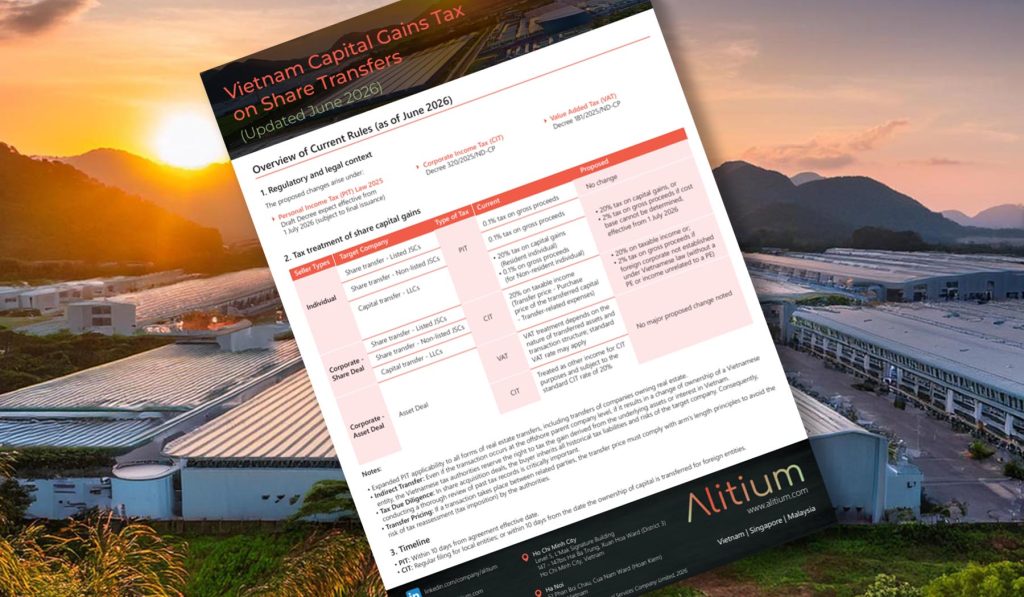
Vietnam Capital Gains Tax on Share Transfers (Updated June 2026)
Alitium’s Vietnam Personal Income Tax Guide 2026 provides practical insights into Vietnam’s evolving PIT framework for employers, HR teams, foreign investors, expatriates, and employees. The guide covers tax residency, payroll withholding, taxable income, deductions, annual tax finalisation, compliance obligations, and common risk areas affecting businesses operating in Vietnam. Designed as a practical reference, it assists organisations in managing payroll and employee tax compliance with greater clarity.
Vietnam Tax Audits 2026 | Inspection Risks, Transfer Pricing & Tax Compliance

Vietnam’s Department of Taxation has identified key risk indicators that are shaping tax audits and inspections in 2026. Businesses reporting sustained losses, low profitability, significant related-party transactions or transfer pricing arrangements may face increased scrutiny. This article examines Official Letter 1927, explains current audit priorities, and outlines practical steps businesses can take to strengthen documentation, tax governance and compliance readiness.
Vietnam’s New E-Labour Contract Framework: What Employers Need to Know Before 1 July 2026

Vietnam is introducing a new electronic labour contract framework under Decree 337/2025/NĐ-CP and Circular 08/2026/TT-BNV, forming part of the country’s broader digital transformation agenda. While e-contracts are not yet mandatory for all businesses, employers should begin preparing for new compliance, platform integration and digital verification requirements before 1 July 2026. This article outlines the practical implications, risks and preparation steps for employers operating in Vietnam.
Vietnam Tightens Investment Proposal Requirements Under Circular 55

Vietnam’s Circular 55/2026/TT-BTC introduces revised investment proposal templates that increase expectations around financial modelling, operational assumptions and socio-economic analysis during the investment licensing process. The changes are likely to require foreign investors to provide more structured feasibility analysis, implementation planning and supporting documentation at an earlier stage. This article examines the practical implications for inbound investors in Vietnam.