Alitium marks second anniversary with expanded regional advisory capabilities across Southeast Asia

Ho Chi Minh City, 10 July 2026 – Alitium today celebrates its second anniversary, marking two years of growth from a single Ho Chi Minh City office to a four-office regional firm across Vietnam, Singapore and Malaysia.
Since its establishment in 2024, the firm has grown alongside increasing cross-border investment activity throughout Southeast Asia, reflecting rising demand for integrated advisory support spanning multiple jurisdictions. Alitium advises multinational corporations, private investors and high-growth businesses investing and operating in Vietnam and the wider region.
Vietnam’s 2026 Tax Code Cleansing Campaign: What Businesses Need to Do to Stay Compliant

Vietnam’s Tax Department has launched its 2026 Tax Code Cleansing Campaign to improve the accuracy of taxpayer records and remove inactive registrations. While administrative in nature, the initiative is expected to increase scrutiny of dormant entities, businesses no longer operating at their registered addresses, and outdated tax registrations. This article outlines the campaign’s objectives, key targets and practical steps businesses should take to ensure ongoing compliance.
Six Personal Income Tax Compliance Mistakes Employers Continue to Make in Vietnam:2026 Edition

Personal Income Tax (PIT) compliance in Vietnam extends well beyond accurate payroll calculations. This article examines six of the most common compliance risks faced by employers, including taxable versus assessable income, non-payroll payments, Form 08 commitments, annual PIT finalisation and new 2026 reporting requirements. Learn practical strategies to strengthen payroll governance, minimise tax exposure and prepare for increasingly digital tax administration.
Vietnam Extends VAT, CIT, PIT and Land Rent Payment Deadlines for Eligible Businesses in 2026

Vietnam has introduced tax payment extensions for eligible businesses, business households and individuals under Decree No. 245/2026/ND-CP. The measures defer payment deadlines for VAT, Corporate Income Tax (CIT), Personal Income Tax (PIT) and certain land rental fees throughout 2026, providing valuable cash flow relief without late payment interest. This article explains eligibility, key deadlines, application requirements and the practical actions businesses should take before the 2 November 2026 application deadline.
Resolution No. 10-NQ/TW: Vietnam’s Next Phase of Foreign Investment

Resolution No. 10-NQ/TW provides an important indication of how Vietnam intends to shape the next phase of foreign investment. While not introducing immediate legal changes, it highlights a stronger focus on investment quality, technology transfer, innovation, sustainability, governance and long-term economic contribution. This article examines the Resolution’s key policy directions and explains what foreign investors should consider when establishing, expanding or acquiring businesses in Vietnam.
Vietnam Tax Guide 2026: A Practical Guide for Investors
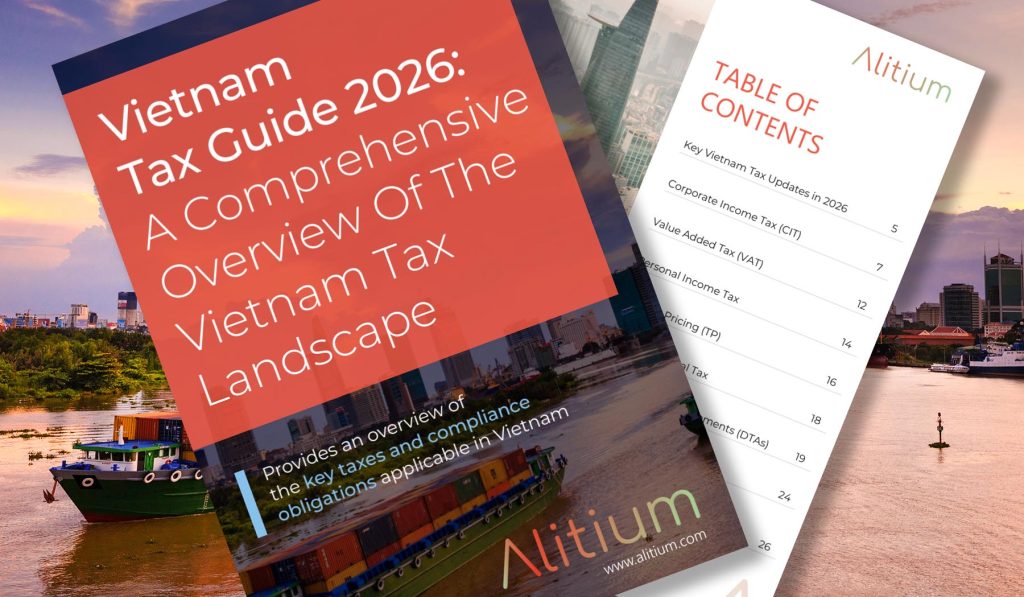
Vietnam’s tax rules are evolving fast, and for foreign investors, the real challenge begins after market entry. Alitium’s Vietnam Tax Guide 2026 breaks down Corporate Income Tax, VAT, Personal Income Tax, transfer pricing, the Global Minimum Tax, Double Taxation Agreements and other compliance obligations in clear, commercially focused language, helping investors, multinational groups and growing businesses make informed decisions and reduce regulatory risk as enforcement in Vietnam continues to tighten
Vietnam Updates Foreign Contractor Tax Rules: Key Changes to FCT Taxable Revenue

Vietnam has introduced significant changes to the calculation of Foreign Contractor Tax (FCT) under Circular 20/2026/TT-BTC. The revised rules broaden the taxable revenue base by including VAT in Corporate Income Tax calculations, potentially increasing tax liabilities for foreign contractors and Vietnamese businesses engaging overseas suppliers. This article explains the new taxable revenue rules, practical implications for gross and net contracts, and key considerations for reviewing existing commercial arrangements.
Hiring Foreign Employees in Vietnam: What Employers Need to Know

Hiring foreign employees in Vietnam requires more than simply obtaining a work permit. Employers must navigate labour laws, employment contracts, payroll, personal income tax, social insurance, expatriate benefits, severance obligations and employee exit requirements. This guide outlines the key legal and practical considerations for employing expatriate staff in Vietnam, helping businesses minimise compliance risks and manage foreign employees throughout the entire employment lifecycle.
Vietnam Country-by-Country Reporting (CbCR) Rules: New Vietnam Tax Guidance for Multinational Groups (2026)

Vietnam’s Tax Department has issued Official Letter 3870/CT-CS, providing important clarification on Country-by-Country Reporting (CbCR) obligations under Decree 132. The guidance confirms that CbCR information will be exchanged directly between tax authorities through international information-sharing mechanisms, rather than through direct taxpayer submissions. Multinational groups should review their transfer pricing documentation, reporting consistency and cross-border compliance frameworks to mitigate audit risk.
Vietnam HR & Payroll Changes: What Employers Must Know Before 1 July 2026

Vietnam’s HR and payroll rules are changing significantly from 1 July 2026. The new Personal Income Tax Law 2025, electronic labour contract framework, and an 8% base salary increase all take effect simultaneously, affecting payroll costs, tax structures, insurance contributions, and employment documentation. For businesses operating in Vietnam, the window to prepare is now