Vietnam’s New PIT & CIT Exemptions & Incentives
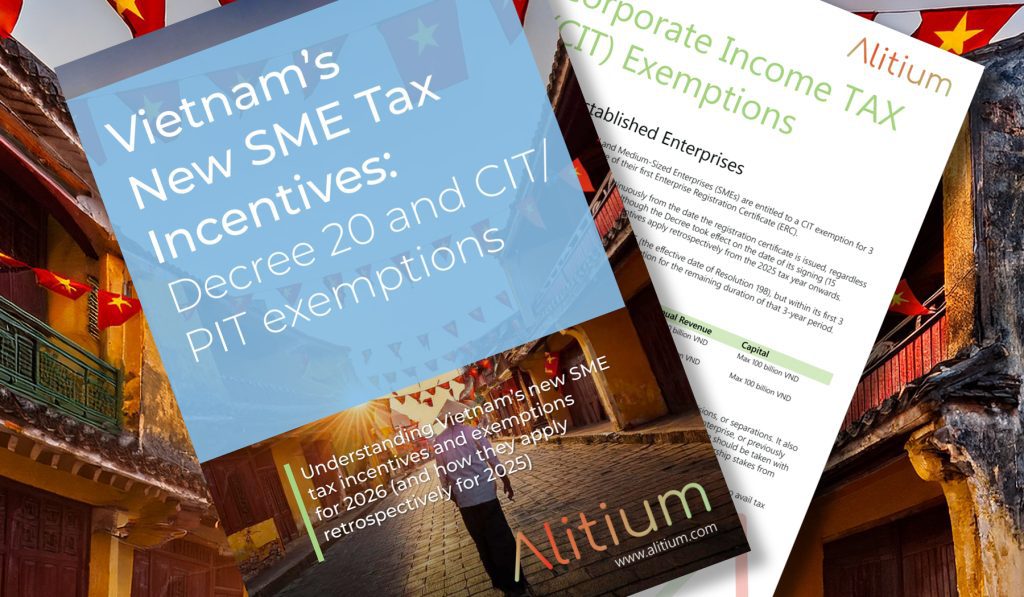
On 15 January 2026, the Government of Vietnam issued Decree No. 20/2026/ND-CP (Decree 20), introducing a comprehensive package of Corporate Income Tax (CIT) and Personal Income Tax (PIT) incentives aimed at accelerating private sector growth, innovation, and startup activity.
Decree 20 provides targeted tax exemptions and reductions for newly established SMEs, innovative startups, startup support organisations, investors, and experts and scientists, with several incentives applying retrospectively from the 2025 tax year. The framework is activity-based rather than size-based, placing emphasis on innovation, research and development, and genuine economic substance.
This guide explains how Decree 20 operates in practice, including eligibility criteria, exemption periods, exclusions, and common risk areas, offering practical insight for foreign-invested enterprises, founders, and investors operating in Vietnam’s evolving tax environment.
Singapore Company Incorporation in 2026

A practical yet comprehensive guide for organizations and businesses considering the establishment of a private limited company in Singapore – one of the world’s leading global business hubs. With a transparent legal framework, streamlined registration procedures, and attractive business support policies, Singapore has become an ideal destination for investors seeking to expand their operations in the Asia-Pacific region.
Vietnam’s Personal Income Tax Law 2025: Impact on Vietnamese Taxpayers in 2026

Vietnam’s Personal Income Tax Law 2025 marks a major reform to the country’s PIT framework, taking effect from 2026. Key changes include increased personal and dependent deductions, simplified progressive tax brackets, expanded tax exemptions, new taxable income categories and targeted incentives for high-tech personnel, startups and green economy activities. This article outlines the practical impacts for employees, individual taxpayers and businesses operating in Vietnam, and highlights compliance considerations ahead of implementation.
Vietnam Year-End 2025 Tax Compliance: Key CIT, PIT and VAT Requirements and Deadlines

Vietnam’s 2025 year-end tax finalisation is a transitional compliance year following major legislative changes to the Corporate Income Tax regime. This guide outlines key deadlines for Corporate Income Tax (CIT), Personal Income Tax (PIT) and VAT filings, required forms and submission requirements, penalty exposure and practical considerations for companies and income-paying organisations operating in Vietnam.
Vietnam’s New Corporate Income Tax Rules: Key Changes Under Decree 320

Decree 320/2025/ND-CP provides detailed guidance on Vietnam’s new Corporate Income Tax Law from December 2025. This article outlines key changes affecting taxable income, loss offsetting, real estate transfers, capital transfers, incentives, and compliance obligations for enterprises operating in Vietnam.
Vietnam’s Investment Law Amendments 2025: Key Changes and Implications for Foreign Investors

Vietnam has enacted sweeping amendments to its Law on Investment, effective from 2026, marking one of the most significant shifts in the country’s foreign investment framework in recent years.
These reforms modernise Vietnam’s regulatory environment by reducing conditional business lines, streamlining licensing and investment procedures, recalibrating incentive regimes, and strengthening oversight for sensitive and large-scale projects. At the same time, the amendments reflect a clear policy direction toward high-technology, green growth, digital transformation, and global value-chain integration.
Invoice Issuance Timing in Vietnam: 2026 Rules and Penalty Framework Explained

Incorrect invoice issuance timing remains one of the most common tax compliance risks for businesses operating in Vietnam. While often unintentional, errors frequently arise from confusion between payment timing, revenue recognition, and statutory invoicing requirements.
This publication explains Vietnam’s core invoice issuance principles under Decree 123/2020/ND-CP and its amendments, together with the significantly revised administrative penalty framework introduced by Decree 310/2025/ND-CP, effective from 16 January 2026.
Vietnam Payroll Guide 2026
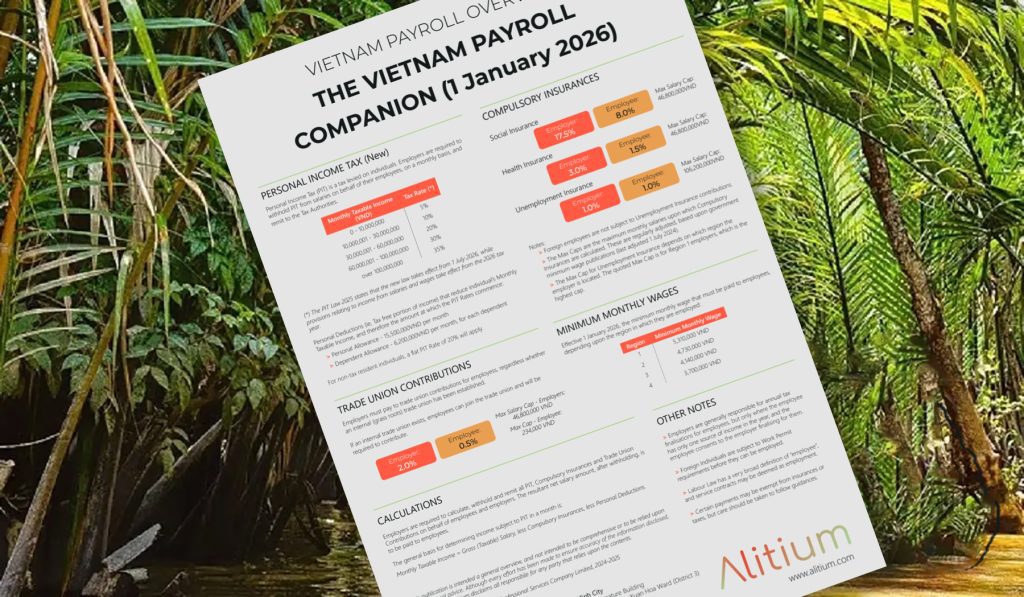
The Alitium Vietnam Payroll Guide 2026 provides employers with a clear and practical overview of Vietnam’s payroll framework, updated to reflect recent legal changes effective for the 2026 tax year.
This edition incorporates key developments under the new Personal Income Tax Law 2025, updated personal and dependent deductions, current PIT rates, compulsory insurance contribution requirements, trade union obligations, and minimum monthly wages effective from 1 January 2026.
Designed for foreign-invested enterprises and Vietnam-based employers, the guide explains employer responsibilities for payroll calculation, withholding, remittance, and compliance, helping businesses manage payroll risk and remain compliant in a rapidly evolving regulatory environment.
Vietnam’s Most Common Tax Risks: The Six Errors That Lead to Back Taxes and Penalties

In Vietnam’s increasingly data-driven tax environment, even minor compliance gaps can lead to significant back taxes, penalties, and audit exposure. Tax authorities now routinely cross-check e-invoices, supplier data, VAT filings, and financial statements, making previously overlooked errors far more visible.
This article outlines the six most common tax risks faced by enterprises in Vietnam — explaining how they arise, when they are typically identified during inspections or audits, the financial and legal consequences, and practical steps businesses can take to mitigate exposure. From non-deductible expenses and invalid VAT invoices to invoice timing errors and data mismatches, understanding these risks is essential for strengthening internal controls and maintaining audit readiness.
Vietnam Labour Compliance: Essential Internal HR Documents

Vietnam’s amended Investment Law allows foreign investors to establish economic organisations prior to obtaining an Investment Registration Certificate (IRC), subject to applicable market access conditions. This reform is designed to streamline market entry, shorten licensing timelines, and enhance administrative efficiency for foreign investment procedures.